 “Love is, without a doubt, the basis of everything. Not some abstract, hard-to-fathom kind of love but the day-to-day kind that everyone knows-the kind of love we feel when we look at our spouse and our children, or even our animals. In its purest and most powerful form, this love is not jealous or selfish, but unconditional. This is the reality of realities, the incomprehensibly glorious truth of truths that lives and breathes at the core of everything that exists or will ever exist, and no remotely accurate understanding of who and what we are can be achieved by anyone who does not know it, and embody it in all of their actions.” ― Eben Alexander, Proof of Heaven: A Neurosurgeon's Journey into the Afterlife

It's more than an attitude. It's a lifestyle
Tuesday, February 9, 2016
Love - the reality of realities
“Love is, without a doubt, the basis of everything. Not some abstract, hard-to-fathom kind of love but the day-to-day kind that everyone knows-the kind of love we feel when we look at our spouse and our children, or even our animals. In its purest and most powerful form, this love is not jealous or selfish, but unconditional. This is the reality of realities, the incomprehensibly glorious truth of truths that lives and breathes at the core of everything that exists or will ever exist, and no remotely accurate understanding of who and what we are can be achieved by anyone who does not know it, and embody it in all of their actions.” ― Eben Alexander, Proof of Heaven: A Neurosurgeon's Journey into the Afterlife

Wednesday, October 21, 2015
Advancing age in all its glory
Is age a bane or a benefit?
reblogged from Crumbs of Comfort

She's causing a problem for her son Gary. "I'm 74," he says with a laugh, "and I can't retire 'cause she's still working! She's sharper than me, no question about it." Felimina isn't just working part-time either. She works six days a week, 11 hours a day, at the College Laundry Shoppe on Maine St. in Buffalo. She drives, and handles all the operations at the laundromat. She attributes her longevity to her hardworking nature, claiming it gives her "a reason to always wake up in the morning and a reason to always hustle." She feels 75 is a good age for most folks to retire, if they have health issues, but she hasn't considered it yet. Maybe baseball star Satchel Paige was right when he said age is a case of mind over matter. "If you don't mind, it doesn't matter."
* * *
See the Daily Mail's video of her in action below:
Tuesday, July 14, 2015
About those bad things that almost happened
 |
| Crisis averted |
"I almost fell."
"Be more careful. You almost dropped that!"
"We almost crashed! We could've been killed!"
Life seems chock full of 'almosts,' and we're pretty vocal about the hazards and potentially awful outcomes of things that didn't happen. But what good does it do to harp on about the bad that could've occurred when, ultimately, it didn't?!
Frankly, it's like being 'almost' pregnant. Either you are, or you're not. There's no being 'sort of' pregnant.
So instead of complaining about all of the things that almost went wrong, perhaps we can all spend a little more time being grateful for what didn't go wrong ... along with the thousand things that went right. ❤
Sunday, July 12, 2015
When being first makes winners of us all
 originally written in support of Positive News Month
In 1909, Louis Blériot made history by being the first person to fly across the English Channel in a heavier than air aircraft, meaning a craft other than a hot air balloon. The Channel has long held fascination for those attempting firsts. It's attracted swimmers, aviators, and all manner of individuals testing human-powered technologies.
At the time of Blériot's crossing, he was an inventor and engineer who created the first practical truck headlamp—an invention that earned him enough money to fund his efforts to build a working aircraft. He went on to make the first piloted monoplane and founded a successful aircraft manufacturing company.
In the intervening years, we've collectively come to take air travel for granted. We often grumble about the high price of tickets, and many were enraged when the government supplied financial bail-outs to airlines. Frankly, we often regard those who control big business as big jerks! For decades we've been barraged by shocking reports of industrial waste and greed. Manufacturing, as a whole, as shown far more interest in profits than in preservation of our world and its resources.
That's why the latest first over the English Channel is so heartening and so important.
On Friday, 10 July 2015, test pilot Didier Esteyne flew the first electric airplane across the channel on behalf of Airbus of France. The flight came on the heels of a similar, though unofficial, battery-operated crossing by independent French pilot Hugues Duval just the day before.
Regardless of who got their first, we all win when companies like Airbus and individuals like Duval take it upon themselves to seek out solutions to the world's sustainable power/pollution crisis. It's a power struggle that actually benefits the whole planet.
To read more about these recent fuel-free flights, visit the Associated Press site.
Friday, July 10, 2015
Fine Dining for Baltimore's Homeless
Reblogged from PositiveNewsMedia.org
Baltimore Magazine reported on the following story:
Baltimore's upheaval and drama took center stage this spring, with imposed curfews shackling citizens as well as small business owners and restaurateurs. July's Baltimore Restaurant Week should help many eateries to make up for their losses. Even so, Michael Tabrizi has a different goal for his restaurant during the July 20-25 dining celebration.
For those five days, Tabrizi's will close its doors to regular business and spend the time feeding the city's homeless. The restaurant has teamed up with local shelters to serve elegant, balanced fine dining meals to the area's disenfranchised.
Visit BaltimoreMagazine.net for more on this grass roots initiative to feed the homeless with dignity and grace.
Baltimore Magazine reported on the following story:
 |
| Michael Tabrizi - as seen in Baltimore Magazine |
For those five days, Tabrizi's will close its doors to regular business and spend the time feeding the city's homeless. The restaurant has teamed up with local shelters to serve elegant, balanced fine dining meals to the area's disenfranchised.
“I decided that, after all of the chaos earlier this year, it would be better to do something for the city to unite the people,” he says. “It isn’t about revenue and money right now, we’ve done restaurant week before and we know the numbers, but right now it’s more important to promote the welfare of the city and its residents rather than to promote the business.”
“These people don’t only suffer from hunger, but also from hopelessness, they feel that they don’t have any dignity anymore,” Tabrizi says. “We want them to come in and feel like they’re cared for.”
“The main goal is just to show people that actions do matter. Baltimore has a long way to recover and we can’t just rely on other people to lead. It’s our city,” Tabrizi says. “My dad used to always say, ‘You can’t control what people do and say, but you can control how you act.’ My reaction is bringing people together and showing them that I care.”
Visit BaltimoreMagazine.net for more on this grass roots initiative to feed the homeless with dignity and grace.
Thursday, January 1, 2015
Feng Shui your mind

Full Definition of FENG SHUI (from Merriam-Webster.com)
: a Chinese geomantic practice in which a structure or site is chosen or configured so as to harmonize with the spiritual forces that inhabit it; also : orientation, placement, or arrangement according to the precepts of feng shui
Origin of FENG SHUI: Chinese (Beijing) fēngshui geomantic omen, literally, wind-water
First Known Use: 1797
The beginning of a new year is a time for contemplation and transformation, often accompanied by a few choice resolutions. Many of us resolve to declutter our homes and work spaces. Doing so streamlines thought, activity and workflow. It makes the things we want and need easier to find. And it affords us the opportunity to get rid of things that no longer work or are no longer used — whether a worn-out frying pan or an article of clothing that's been sitting in the back of the closet for years with its original price tag intact.
Imagine how the practice of decluttering could benefit us when applied to the thoughts that fill our minds! To make way for new healthy thoughts about ourselves and our surroundings, it's imperative that we remain vigilant in our efforts to get rid of what no longer works for us and what we've outgrown. Thoughts such as negativity, envy, self-loathing, procrastination, comparing ourselves to others, worrying about what others think should be ousted from our mental closets daily as they are never attractive on us.
It isn't enough to just get rid of uncomely thoughts, lest we go naked. No, we need to replace them with thoughts that are lovely and always in fashion — thoughts of wholeness, completeness, grace, kindness, usefulness, true success, true value and worth — these are the thoughts we can begin to clothe ourselves in immediately. And what is the result? All who see us will recognize our innate beauty and attractiveness. And we'll feel fabulous.
May 2015 bring you innumerable opportunities to declutter your mental house and fill it with thoughts of beauty and light. The truth is, you deserve nothing less.
Tuesday, September 23, 2014
When you don't know...
When you don't know what purpose your life serves
When you don't know if you make a bit of difference
When you don't know what the point is of getting up in the morning
When you don't know why you're here
watch this video
Wednesday, September 3, 2014
When to sugarcoat

sug·ar·coat
transitive verb \ˈshu̇-gər-ˌkōt\
: to talk about or describe (something) in a way that makes it seem more pleasant or acceptable than it is
"Don't sugar-coat it. Give it to me straight!"
We've all said or heard similar sentiments at one time or another. We often don't want people to gloss over hard truths. We want to get to the meat of the situation, see what we're really dealing with, handle it, and move on.
So then, when, if ever, is it appropriate to sugarcoat things? The video below shows the creation of a simple confection: cotton candy. But rather than just cranking out yet another cocoon of spun sugar, the vendor takes the extra time and goes to the extra effort of creating a delightful work of art. And what girl doesn't appreciate having a kind man give her a flower?!
The same care and thoughtfulness can go into everything we do in our daily round. Kindness needn't be laborious... but even if it is, so what? There is more to life than multi-tasking, hyper-efficiency, carb-cutting, calorie-counting, penny scrimping, and living in a mild sense of self-induced deprivation. The investment you make by adding the sprinkles to the ice cream cone, delivering breakfast in bed, running an errand for a loved one even though it's out of the way and you're exhausted... these investments bring in a return that is instant as well as compounding. Plus, it feels good!
What ways can you set your creativity and thoughtfulness loose on those around you? Who knows, you may do something that inspires people and ends up going viral on Youtube too!
Tuesday, August 5, 2014
Cultivating Joy on one hand

So how do we go about cultivating it?
Especially when our health, relationships, finances or circumstances feel like they are draining the joy out of our lives?
Like anything, it can take work. But it needn't be drudgery. Regardless of your situation, here's a handful of ways you can begin to cultivate joy today. And you can expect some of these efforts to bear beautiful fruits on the spot!
- Choose gratitude - No single act works as quickly to turn around your perspective and immediate experience than that of gratitude. Whether you're grateful for the fact that you can walk, the food in your pantry, the convenience of indoor plumbing or the benefits of the internet, there is always something for which to be grateful. It really is a choice, and one you can make right now
- Do unto yourself - Self-care is the buzz word of the day, and for good reason. We've all heard that during air travel you must put your own oxygen mask on before helping others. It may sound selfish at first, but upon reflection, one realizes that to be of assistance to others you must be okay yourself. Make sure to practice the thoughts and activities that make you feel loved and healthy in mind and spirit
- Look out - Once we've centered and cared for ourselves, it's time to help those around us -- not just loved ones, but those with whom we come in contact. So often we focus so intently on our problems that we become bogged down by them. A great way to stop this depressing contraction is to regard others and their challenges, and seek to be of assistance. It gets us 'out of our heads' and helps to bring balance to our thought. And you just might find there is already a lot of good going on in this world, as inspired and orchestrated by others who decided to 'look out' for others
- Look up - Regardless of any religious beliefs, we all believe in something. And most of us believe in the power of love. Whatever you personally believe in, make time each and every day... preferably at the beginning of the day to tap into and get a greater understanding of your personal belief system
- Look around - There is no denying that we live in an exquisite universe. Take a moment to really look at the beauty of nature that is all around, and plan to spend at least a little time enjoying nature on a regular basis
While this list could go on indefinitely, these 5 simple tools should come in handy when working to water and nurture your joy garden. May your joy grow like weeds!

Tuesday, May 21, 2013
Tipping the scales of kindness
 |
| "I have always depended on the kindness of strangers." ~Blanche Dubois, A Streetcar Named Desire |
Perhaps the chief point of outrage was the bistro's policy (to date) of paying their service staff an hourly rate, while owner Samy, who taps orders into the POS system, admittedly keeps the tips for himself. Not only has this practice affected their employees, but the patrons who leave gratuities in the belief that the funds go directly to the person who took and delivered their orders. The epic backlash has included petitions calling for legal action against the eatery, exposure of the owner's criminal past, and a torrent of vitriol on Facebook, Yelp and Reddit that would've crashed lesser servers... meaning computer sites, not wait staff.
In an economy still limping along and searching to find its feet, the idea of struggling young workers being denied their tips by their millionaire boss leaves a bad taste in America's mouth—more so than anything diners might return to Amy's kitchen. But just when one feels this world's greed is too much to bear, a brief Tumblr post from a cynic, a CasualCynic to be exact, turns the notion of unfair selfishness on its head. Get a load of the original post:
—SO MY MOM AND I HAVE BEEN WORKING THE SAME WAITRESS JOB FOR 5-6 YEARS NOW. SHE HAD BEEN WAITRESSING YEARS BEFORE, BUT THIS IS RECENTLY. ANYWAY, ABOUT… 15 MINUTES AGO THIS GUY SHE WAITED ON LEFT AND TOLD HER TO TAKE CARE. JUST THAT. PRIOR TO THIS SHE HAD TALKED TO HIM ABOUT ITALY. HER PEOPLE ARE FROM FLORENCE, THIS AND THAT, AND SHE SAID SHE’S NEVER BEEN. SHE’S GOT 8 YEARS OF ART EDUCATION AND SHE’S WORKING A WAITRESS JOB. IT’S PRETTY… SAD AND DISAPPOINTING, I GUESS. HER AND MY FATHER DIVORCED 6 YEARS AGO AND SHE HASN’T HAD A REAL JOB EVER. JUST BEEN STUCK IN A SMALL TOWN SHE’S NOT FROM. THIS MAN WHO WE HAVE NEVER SEEN BEFORE TIPPED HER 1000 DOLLARS FOR A TRIP TO ITALY. WALKED OUT, NOT ANOTHER WORD.

…YOU KNOW. JUST WHEN I START TO LOSE FAITH IN HUMANITY….HM.—So buck up, ye who can no longer bear the doom and gloom of daily news. Good deeds are still done, even by strangers.
Thursday, June 28, 2012
Taking Tea with Tolkien, Part I
Satisfy your inner hobbit with this traditional hearty high tea recipe, reblogged from Recipewise.co.uk... Steep a pot of English Breakfast and visit their site for helpful step by step instructions. Cheers!
 As a child and living so close Tolkien might perhaps have been a fan of the properly made and commercially sold Melton Mowbray Pork Pie. There really is no other pork pie quite it’s equal. Melton, in Mowbray, Leicestershire, is the area located from where these famous Victorian pies were first sold (from the 1830′s). Made with a hot water crust pastry and proper pork ‘jelly’ this would have been a firm favourite taken at tea. Today, when people say pork pie, this is the standard pie they think of. We would make a large, round, hand-raised pie for this, following the recipe given.
Melton in Mowbray is a small market town located in north Leicester, central England; an area also famous for its Stilton Cheese. Although made earlier in the local rural farms in Mowbray the first of these now famous pies started to appear commercially in the 1830′s and have been on sale ever since. Under European Law only pies made within a designated zone around Melton, and using uncured pork, are allowed to carry the Melton Mowbray name on their packaging, (if sold commercially). The most traditional, and the best Pork Pies sold in Melton are still the hand-made and hand-raised ones, as given in the Victorian recipe below. The pie pastry, when freshly made (unlike a long-life shop bought pie) is fantastic, crispy on the outside and soft and yielding on the inside, from being soaked in the stock. A stock (to form the clear jelly) is always added to the hand-cut pork pie filling after baking, it is added because the meat expands during cooking and shrinks on cooling, leaving a gap under the pie lid.
The Original MELTON MOWBRAY PORK PIE Recipe
 This recipe comes from a collection of local and regional recipes handed down within families who lived and worked in Leicestershire, many dating from the 1800s, via ‘Country Dishes’ by Barbara Hargreves (Ed.) published in 1962.
To make 1 pie: The Crust. 3/4 lb plain flour, 6 oz lard, 1/2 teaspoonful salt, 4 fluid oz water.
The Filling: 1 lb pork (failing flitch, use shoulder, and if bought buy 1 1/4 lb (625g) to allow trimming) 1 level teaspoonful salt, 1/2 level teaspoonful pepper, 2 tablespoonfuls water.
The Crust. Put lard and water in saucepan and bring to the boil to melt the lard. Meanwhile weigh and sieve flour and salt, then pour lard and water (while still boiling) over the flour and mix well. Knead well by hand. Leave to cool about and hour but during this time knead once or twice. The dough must not get really cold otherwise it will crack and crumble. Turn onto floured board. Flour mould (the traditional Leicestershire pie mould is wooden, but a 2 lb jam-jar will do), put crust on top of mould and shape it from the top some way down the sides. The crust should be about 1/3 inch (1cm) thick. Leave to set for 20 minutes, then turn crust of mould and trim with scissors.
The Filling. Mince the meat on coarse knife of mincer or chop finely with a knife; add salt and pepper and mix in, add water and mix again. Press meat well into corners of pie, filling within 3/4 inch (2cm) of the top. Make the lid out of the pastry trimmings, press the edges together. Cut round to neaten off – this cutting also helps to bind the top and sides together. Castellate the top with thumb and first finger, make one hole with a skewer and decorate with stars or leaves.
Cut a length of greaseproof paper about 1 inch (2.5cm) higher than the pie, wind it round the pie making sure it goes right down the bottom, and stick it together with flour paste. This holds the pie in position. The pie need not be baked on the same day – in fact it is improved by standing overnight.
To cook, put the pie on a sandwich tin with 1 inch (2.5cm) edges – allowing plenty of room around the pie – and place on baking tray. Cook at 350 degrees F (180C) for the first hour, then turn oven to 300 degrees F (160C) and give pie another 45 minutes. The sandwich tin will re-absorb the fat. When the pie is nearly cold make a small hole in the top and add jelly. The jelly is made from bones and rind, just covered with water, simmered for 2 hours, then strained and seasoned. It should be poured into pie 1 hour after it comes out of oven.


Melton in Mowbray is a small market town located in north Leicester, central England; an area also famous for its Stilton Cheese. Although made earlier in the local rural farms in Mowbray the first of these now famous pies started to appear commercially in the 1830′s and have been on sale ever since. Under European Law only pies made within a designated zone around Melton, and using uncured pork, are allowed to carry the Melton Mowbray name on their packaging, (if sold commercially). The most traditional, and the best Pork Pies sold in Melton are still the hand-made and hand-raised ones, as given in the Victorian recipe below. The pie pastry, when freshly made (unlike a long-life shop bought pie) is fantastic, crispy on the outside and soft and yielding on the inside, from being soaked in the stock. A stock (to form the clear jelly) is always added to the hand-cut pork pie filling after baking, it is added because the meat expands during cooking and shrinks on cooling, leaving a gap under the pie lid.
The Original MELTON MOWBRAY PORK PIE Recipe

To make 1 pie: The Crust. 3/4 lb plain flour, 6 oz lard, 1/2 teaspoonful salt, 4 fluid oz water.
The Filling: 1 lb pork (failing flitch, use shoulder, and if bought buy 1 1/4 lb (625g) to allow trimming) 1 level teaspoonful salt, 1/2 level teaspoonful pepper, 2 tablespoonfuls water.
The Crust. Put lard and water in saucepan and bring to the boil to melt the lard. Meanwhile weigh and sieve flour and salt, then pour lard and water (while still boiling) over the flour and mix well. Knead well by hand. Leave to cool about and hour but during this time knead once or twice. The dough must not get really cold otherwise it will crack and crumble. Turn onto floured board. Flour mould (the traditional Leicestershire pie mould is wooden, but a 2 lb jam-jar will do), put crust on top of mould and shape it from the top some way down the sides. The crust should be about 1/3 inch (1cm) thick. Leave to set for 20 minutes, then turn crust of mould and trim with scissors.
The Filling. Mince the meat on coarse knife of mincer or chop finely with a knife; add salt and pepper and mix in, add water and mix again. Press meat well into corners of pie, filling within 3/4 inch (2cm) of the top. Make the lid out of the pastry trimmings, press the edges together. Cut round to neaten off – this cutting also helps to bind the top and sides together. Castellate the top with thumb and first finger, make one hole with a skewer and decorate with stars or leaves.
Cut a length of greaseproof paper about 1 inch (2.5cm) higher than the pie, wind it round the pie making sure it goes right down the bottom, and stick it together with flour paste. This holds the pie in position. The pie need not be baked on the same day – in fact it is improved by standing overnight.
To cook, put the pie on a sandwich tin with 1 inch (2.5cm) edges – allowing plenty of room around the pie – and place on baking tray. Cook at 350 degrees F (180C) for the first hour, then turn oven to 300 degrees F (160C) and give pie another 45 minutes. The sandwich tin will re-absorb the fat. When the pie is nearly cold make a small hole in the top and add jelly. The jelly is made from bones and rind, just covered with water, simmered for 2 hours, then strained and seasoned. It should be poured into pie 1 hour after it comes out of oven.

Friday, June 1, 2012
Light as a swan feather, the dessert fit for a ballerina
Pavlova is a meringue-based dessert named after the Russian ballet dancer Anna Pavlova. It is a meringue dessert with a crisp crust and soft, light inside. The name is pronounced /pævˈloʊvə/ or /pɑːvˈloʊvə/, unlike the name of the dancer, which was /ˈpɑːvləvə/ or /ˈpævləvə/.
The dessert is believed to have been created in honour of the dancer either during or after one of her tours to Australia and New Zealand in the 1920s.
The following listed as the "best" pav recipe, from AllRecipes.com
 Ingredients
Servings: 12
Amount Per Serving Calories: 186
Total Fat: 9.3g
Cholesterol: 34mg
Here is the link showing how to build the gorgeous swan pav shown
The nationality of its creator has been a source of argument between the two nations for many years, but formal research indicates New Zealand as the source. The dessert is a popular dish and an important part of the national cuisine of both countries, and with its simple recipe, is frequently served during celebratory and holiday meals.
Origin
Research shows the recipe originated in New Zealand.[6] Keith Money, a biographer of Anna Pavlova, wrote that a hotel chef in Wellington, New Zealand, created the dish when Pavlova visited there in 1926 on her world tour.
Professor Helen Leach, a culinary anthropologist at the University of Otago in New Zealand, has compiled a library of cookbooks containing 667 pavlova recipes from more than 300 sources.[6] Her book, The Pavlova Story: A Slice of New Zealand’s Culinary History, states that the first Australian pavlova recipe was created in 1935 while an earlier version was penned in 1929[2] in the rural magazine.
The Australian website "Australian Flavour" gives the earlier date of 1926 for its creation, suggesting that Home Cookery for New Zealand, by Australian writer Emily Futter, contained a recipe for "Meringue with Fruit Filling". This recipe was similar to today's version of the dessert.
 It has been claimed that Bert Sachse created the dish at the Esplanade Hotel in Perth, Australia in 1935. In defence of his claim as inventor of the dish, a relative of Sachse's wrote to Leach suggesting that Sachse may have accidentally dated the recipe incorrectly. Leach replied they would not find evidence for that "because it's just not showing up in the cookbooks until really the 1940s in Australia." (However, a 1937 issue of the Australian Women's Weekly contains a "pavlova sweet cake" recipe.) Of such arguments, Matthew Evans, a restaurant critic for The Sydney Morning Herald, said that it was unlikely that a definitive answer about the pavlova's origins would ever be found. "People have been doing meringue with cream for a long time, I don't think Australia or New Zealand were the first to think of doing that."
The first known recorded recipe named "pavlova" was published in the fifth Australian edition of Davis Dainty Dishes in 1926. However this "pavlova" recipe was not meringue based, but was instead a multi-coloured gelatine dish.
A newspaper article from January 1927 claims an American ice-cream was named after Pavlova: "Dame Nellie Melba, of course, has found fame apart from her art in the famous sweet composed of peaches and cream, while Mme. Anna Pavlova lends her name to a popular variety of American ice-cream." Preparation and consumption
Pavlova is made by beating egg whites (and sometimes salt) to a very stiff consistency before folding in caster sugar, white vinegar, cornflour, and sometimes vanilla essence, and slow-baking the mixture, similarly to meringue.
The major difference between the pavlova and a large meringue is the addition of cornflour, which results in the pavlova having a crisp and crunchy outer shell, and a soft, moist marshmallow-like centre, unlike meringue which is usually solid throughout. The consistency also makes the pavlova significantly more fragile than meringue. Because the Pavlova is notorious for deflating if exposed to cold air, when cooking is complete it is left in the oven to fully cool down before the oven door is opened.
Pavlova is traditionally decorated with a topping of whipped cream and fresh soft fruit such as kiwifruit, passionfruit, and strawberries. Factory-made pavlovas can be purchased at supermarkets and decorated as desired. A commercial product is available that includes pre-mixed ingredients for baking the meringue shell, requiring only the addition of water and sugar.
Leftover decorated pavlova can be refrigerated overnight, but the dessert will absorb moisture and lose its crispness. Undecorated pavlova can be left overnight in the oven, or for several days in an airtight container, to be decorated when ready.
In culture
World's largest pavlova -- Te Papa, New Zealand's national museum in Wellington, celebrated its first birthday in February 1999 with the creation of the world's largest pavlova, named "Pavzilla", which was cut by the Prime Minister of the time, Jenny Shipley. This record was broken by students at the Eastern Institute of Technology in Hawke's Bay, New Zealand in March 2005. Their creation 'Pavkong' stretched 64 metres long in comparison to Te Papa's 45 metre long pavlova. In August 2010, chef Aaron Campbell displayed a 50 square metre rugby-themed pavlova, with the Bledisloe Cup in the centre, in the ChristChurch Cathedral in Christchurch, to raise money for the official charity of the All Blacks.
NZI advertising campaign -- In 2007, insurance company NZI ran a humorous series of television advertisements in New Zealand highlighting what are locally considered to be historic New Zealand icons being adopted elsewhere, including the pavlova playing on its status as a common feature of the friendly trans-Tasman rivalry. NZI's parent company is Australian owned.
[fact source: Wikipedia]
The following listed as the "best" pav recipe, from AllRecipes.com

- 3 egg whites
- 1 pinch salt
- 1 cup white sugar
- 1 tablespoon cornstarch
- 1 teaspoon lemon juice
- 1 1/4 cups heavy whipping cream
- 1/2 cup confectioners' sugar
- 1 pint fresh strawberries
- Preheat oven to 300 degrees F (150 degrees C). Line a sheet pan with parchment paper. Draw a 9 inch circle on the parchment. An easy way to do this is to draw around the outside of a 9 inch pan with a pencil.
- In a large bowl, beat egg whites on high speed until soft peaks form. Add 3/4 cup of the sugar gradually, while continuing to whip. Make sure sugar is completely dissolved. Mix together the remaining 1/4 cup sugar with the cornstarch; lightly fold into meringue with lemon juice.
- Spread a layer of meringue to fit circle on parchment, approximately 1/4 inch thick. With remainder of mixture, pipe or spoon swirls around the edges to form a shallow bowl shape.
- Bake at 300 degrees F (150 degrees C) for 1 hour. Turn off oven, but leave meringue in oven for an additional 30 minutes. When cool, the meringue should be hard on the outside, and slightly moist on the inside.
- In a large bowl, combine the cream and half a cup of confectioners sugar, and whip until thickened. Decorate with fruit of your choice; strawberries are excellent.
Servings: 12
Amount Per Serving Calories: 186
Total Fat: 9.3g
Cholesterol: 34mg
Here is the link showing how to build the gorgeous swan pav shown
The nationality of its creator has been a source of argument between the two nations for many years, but formal research indicates New Zealand as the source. The dessert is a popular dish and an important part of the national cuisine of both countries, and with its simple recipe, is frequently served during celebratory and holiday meals.
Origin
Research shows the recipe originated in New Zealand.[6] Keith Money, a biographer of Anna Pavlova, wrote that a hotel chef in Wellington, New Zealand, created the dish when Pavlova visited there in 1926 on her world tour.
Professor Helen Leach, a culinary anthropologist at the University of Otago in New Zealand, has compiled a library of cookbooks containing 667 pavlova recipes from more than 300 sources.[6] Her book, The Pavlova Story: A Slice of New Zealand’s Culinary History, states that the first Australian pavlova recipe was created in 1935 while an earlier version was penned in 1929[2] in the rural magazine.
The Australian website "Australian Flavour" gives the earlier date of 1926 for its creation, suggesting that Home Cookery for New Zealand, by Australian writer Emily Futter, contained a recipe for "Meringue with Fruit Filling". This recipe was similar to today's version of the dessert.
 It has been claimed that Bert Sachse created the dish at the Esplanade Hotel in Perth, Australia in 1935. In defence of his claim as inventor of the dish, a relative of Sachse's wrote to Leach suggesting that Sachse may have accidentally dated the recipe incorrectly. Leach replied they would not find evidence for that "because it's just not showing up in the cookbooks until really the 1940s in Australia." (However, a 1937 issue of the Australian Women's Weekly contains a "pavlova sweet cake" recipe.) Of such arguments, Matthew Evans, a restaurant critic for The Sydney Morning Herald, said that it was unlikely that a definitive answer about the pavlova's origins would ever be found. "People have been doing meringue with cream for a long time, I don't think Australia or New Zealand were the first to think of doing that."
The first known recorded recipe named "pavlova" was published in the fifth Australian edition of Davis Dainty Dishes in 1926. However this "pavlova" recipe was not meringue based, but was instead a multi-coloured gelatine dish.
A newspaper article from January 1927 claims an American ice-cream was named after Pavlova: "Dame Nellie Melba, of course, has found fame apart from her art in the famous sweet composed of peaches and cream, while Mme. Anna Pavlova lends her name to a popular variety of American ice-cream." Preparation and consumption
Pavlova is made by beating egg whites (and sometimes salt) to a very stiff consistency before folding in caster sugar, white vinegar, cornflour, and sometimes vanilla essence, and slow-baking the mixture, similarly to meringue.
The major difference between the pavlova and a large meringue is the addition of cornflour, which results in the pavlova having a crisp and crunchy outer shell, and a soft, moist marshmallow-like centre, unlike meringue which is usually solid throughout. The consistency also makes the pavlova significantly more fragile than meringue. Because the Pavlova is notorious for deflating if exposed to cold air, when cooking is complete it is left in the oven to fully cool down before the oven door is opened.
Pavlova is traditionally decorated with a topping of whipped cream and fresh soft fruit such as kiwifruit, passionfruit, and strawberries. Factory-made pavlovas can be purchased at supermarkets and decorated as desired. A commercial product is available that includes pre-mixed ingredients for baking the meringue shell, requiring only the addition of water and sugar.
Leftover decorated pavlova can be refrigerated overnight, but the dessert will absorb moisture and lose its crispness. Undecorated pavlova can be left overnight in the oven, or for several days in an airtight container, to be decorated when ready.
In culture
World's largest pavlova -- Te Papa, New Zealand's national museum in Wellington, celebrated its first birthday in February 1999 with the creation of the world's largest pavlova, named "Pavzilla", which was cut by the Prime Minister of the time, Jenny Shipley. This record was broken by students at the Eastern Institute of Technology in Hawke's Bay, New Zealand in March 2005. Their creation 'Pavkong' stretched 64 metres long in comparison to Te Papa's 45 metre long pavlova. In August 2010, chef Aaron Campbell displayed a 50 square metre rugby-themed pavlova, with the Bledisloe Cup in the centre, in the ChristChurch Cathedral in Christchurch, to raise money for the official charity of the All Blacks.
NZI advertising campaign -- In 2007, insurance company NZI ran a humorous series of television advertisements in New Zealand highlighting what are locally considered to be historic New Zealand icons being adopted elsewhere, including the pavlova playing on its status as a common feature of the friendly trans-Tasman rivalry. NZI's parent company is Australian owned.
[fact source: Wikipedia]
Friday, May 11, 2012
Putting Mom on a Pedestal .... a Cake Pedestal
This exquisite confection is a labor of love, but the results are well worth the effort
TOTAL TIME:2 hr 20 min, Prep:2 hr 0 min, Inactive Prep:--
Cook:20 min
YIELD:One 8-inch cake, LEVEL:Difficult
INGREDIENTS
SPONGE CAKE:

LEMON CURD:
MERINGUE:
MOTHER'S DAY CAKE:
DIRECTIONS
Baking the Lemon Sponge:
Preheat oven to 350degreesF, with rack in center of the oven. Line two 8-inch cake pans with parchment paper and grease the paper. Beat the sugar, zest, and eggs in a stand mixer using the whip attachment, on high speed for about 5 minutes. The eggs will be light in color and very thick. Sift the flour over the egg mixture and fold it in carefully with a rubber spatula. Pour into the prepared pans and quickly spread it out evenly. Bake for about 18-20 minutes or until a tester comes out clean.
To make the Lemon Curd:
In a large bowl, whisk together the yolks and sugar. Whisk in the lemon juice, salt and zest. Place the bowl over a medium sized saucepot that has an inch of simmering water in it. Using a tempered rubber spatula stir the lemon mixture over the heat until it thickens. This can take 5 to 10 minutes. As the lemon curd thickens it should cling to the rubber spatula. It will be thick like a pudding. Remove from the heat and stir in the butter. Strain the curd into a container and cover with plastic. Put in the freezer for about 15 minutes, or until the curd is cold but not frozen. Remove and place in refrigerator until ready to use. It will be good for up to 5 days in the refrigerator.
To make the meringue:
Whisk together the egg whites, sugar and salt in the bowl of your stand mixer. Rest the bowl over a pot of simmering water to form a double boiler. Scrape down the sides of the bowl so that all the sugar is off the sides of the bowl. Continue to stir the mixture until all the sugar is melted into the eggs and you no longer feel any graininess when rubbed between your fingers, about 3-5 minutes. Place the bowl onto your mixer, add the vanilla and salt, whisk on high speed until the meringue is thick and glossy and the bowl is just warmer than room temperature, about 8 minutes.
To assemble the cake:
Cut each of the cakes in 2 layers. Place one layer of the cake on a 8-inch cardboard cake round. Spread 1/4 cup preserves on the cake, followed by 1/4 cup lemon curd. Repeat with the next two layers of cake, preserves and lemon curd. Finally, top with the last layer of cake. To decorate the cake: Use a large rose tip, to make the flowers and to pipe the striped base. Starting at the top edge of the cake with the narrow end of the rose tip facing up, pipe a continuous spiral all the way down the cake, being careful to overlap the previous stripe. Use a propane blowtorch to lightly toast the meringue; which gives it a lovely marshmallow flavor. (Be very careful to do this on a fireproof surface.) The cake can also be served without toasting the meringue; the pure white icing is also gorgeous. For information and a how-to video about piping the roses visit www.zoebakes.com.
YIELD:One 8-inch cake, LEVEL:Difficult
INGREDIENTS
SPONGE CAKE:

- 1 cup flour
- 2/3 cup sugar
- 1 teaspoon zest of lemon
- 5 large eggs, room temperature
LEMON CURD:
- 6 large egg yolks
- 1 cup sugar
- 3/4 cup lemon juice
- pinch salt
- zest of 1 lemon
- 2 tablespoons unsalted butter
MERINGUE:
- 1 cup egg whites
- 2 cups sugar
- 1/2 teaspoon vanilla
- pinch salt
MOTHER'S DAY CAKE:
- 1 recipe Sponge Cake (see above)
- 1 recipe Lemon Curd (see above)
- 1 recipe Meringue (see above)
- 3/4 cup raspberry jam
DIRECTIONS
Baking the Lemon Sponge:
Preheat oven to 350degreesF, with rack in center of the oven. Line two 8-inch cake pans with parchment paper and grease the paper. Beat the sugar, zest, and eggs in a stand mixer using the whip attachment, on high speed for about 5 minutes. The eggs will be light in color and very thick. Sift the flour over the egg mixture and fold it in carefully with a rubber spatula. Pour into the prepared pans and quickly spread it out evenly. Bake for about 18-20 minutes or until a tester comes out clean.
To make the Lemon Curd:
In a large bowl, whisk together the yolks and sugar. Whisk in the lemon juice, salt and zest. Place the bowl over a medium sized saucepot that has an inch of simmering water in it. Using a tempered rubber spatula stir the lemon mixture over the heat until it thickens. This can take 5 to 10 minutes. As the lemon curd thickens it should cling to the rubber spatula. It will be thick like a pudding. Remove from the heat and stir in the butter. Strain the curd into a container and cover with plastic. Put in the freezer for about 15 minutes, or until the curd is cold but not frozen. Remove and place in refrigerator until ready to use. It will be good for up to 5 days in the refrigerator.
To make the meringue:
Whisk together the egg whites, sugar and salt in the bowl of your stand mixer. Rest the bowl over a pot of simmering water to form a double boiler. Scrape down the sides of the bowl so that all the sugar is off the sides of the bowl. Continue to stir the mixture until all the sugar is melted into the eggs and you no longer feel any graininess when rubbed between your fingers, about 3-5 minutes. Place the bowl onto your mixer, add the vanilla and salt, whisk on high speed until the meringue is thick and glossy and the bowl is just warmer than room temperature, about 8 minutes.
To assemble the cake:
Cut each of the cakes in 2 layers. Place one layer of the cake on a 8-inch cardboard cake round. Spread 1/4 cup preserves on the cake, followed by 1/4 cup lemon curd. Repeat with the next two layers of cake, preserves and lemon curd. Finally, top with the last layer of cake. To decorate the cake: Use a large rose tip, to make the flowers and to pipe the striped base. Starting at the top edge of the cake with the narrow end of the rose tip facing up, pipe a continuous spiral all the way down the cake, being careful to overlap the previous stripe. Use a propane blowtorch to lightly toast the meringue; which gives it a lovely marshmallow flavor. (Be very careful to do this on a fireproof surface.) The cake can also be served without toasting the meringue; the pure white icing is also gorgeous. For information and a how-to video about piping the roses visit www.zoebakes.com.
[source: Cooking Channel TV]
Thursday, March 29, 2012
When life gives you lemons... make a chiffon pie!
It’s National Lemon Chiffon Cake Day! An insurance salesman named Harry Baker invented chiffon cake in the 1920s. He sold his cakes to the Brown Derby restaurant in Los Angeles and all of Hollywood fell in love with the dessert’s lighter-than-air texture. Baker carefully guarded the recipe for over twenty years before selling it to General Mills (home of the Betty Crocker brand) for an undisclosed amount.
The recipe for chiffon cake debuted in a 1948 edition of Better Homes and Gardens. General Mills marketed it as “the first new cake in 100 years” and it quickly became a nationwide sensation. The secret recipe called for vegetable oil instead of butter or shortening, and instructed the baker to beat the egg whites and egg yolks separately.
There are many flavors of chiffon cake including chocolate, orange, walnut, maple, and today’s reason to celebrate, lemon! To celebrate National Lemon Chiffon Cake Day, try baking a delicious lemon chiffon cake for your family tonight!" [punchbowl.com]
Ingredients
- 7 eggs, separated
- 2 cups all-purpose flour
- 1-1/2 cups sugar
- 3 teaspoons baking powder
- 1 teaspoon salt
- 3/4 cup water
- 1/2 cup canola oil
- 4 teaspoons grated lemon peel
- 2 teaspoons vanilla extract
- 1/2 teaspoon cream of tartar

- 1/3 cup butter, softened
- 3 cups confectioners' sugar
- 1/4 cup lemon juice
- 4-1/2 teaspoons grated lemon peel
- Dash salt
Directions
- Place egg whites in a large bowl; let stand at room temperature for 30 minutes.
- In a large bowl, combine the flour, sugar, baking powder and salt. In another bowl, whisk the egg yolks, water, oil, lemon peel and vanilla; add to dry ingredients and beat until well blended. Add cream of tartar to egg whites; beat on medium speed until soft peaks form. Fold into batter.
- Gently spoon into an ungreased 10-in. tube pan. Cut through batter with a knife to remove air pockets. Bake on the lowest oven rack at 325° for 50-55 minutes or until cake springs back when lightly touched. Immediately invert pan; cool completely, about 1 hour.
- Run a knife around sides and center tube of pan. Remove cake to a serving plate. In a small bowl, combine frosting ingredients; beat until smooth. Frost top of cake. Yield: 12-16 servings.
Nutritional Facts1 slice equals 345 calories, 13 g fat (4 g saturated fat), 100 mg cholesterol, 288 mg sodium, 54 g carbohydrate, 1 g fiber, 4 g protein.
Sunday, March 11, 2012
Coffee Spanish Torrijas
Ingredients:

- 1 (14 oz.) can Sweetened Condensed Milk, divided
- 1/3 cup strong brewed coffee, plus 4 tsp., divided
- 3/4 teaspoon vanilla extract
- 1 large egg
- 2 to 3 tablespoons butter
- 1 (6 oz.) loaf French bread, cut into 16 (1/2-inch) slices
- Ground cinnamon
Instructions:
- HEAT oven to 250°F. Place small baking sheet in oven.
- WHISK together 2/3 cup sweetened condensed milk, 1/3 cup coffee and vanilla in large bowl. Whisk egg in medium shallow bowl until blended.
- HEAT 1 tablespoon oil in large skillet over medium heat. Dip one bread slice at a time in milk mixture, then in beaten egg, turning to coat both sides. Place 5 to 6 slices in heated skillet. Cook until browned, about 1 to 2 minutes per side. Place on baking sheet in oven to keep warm. Repeat with remaining slices adding more oil as needed.
- COMBINE remaining sweetened condensed milk and 4 teaspoons coffee in small bowl to make topping. Drizzle topping over warm bread slices just before serving. Sprinkle with cinnamon.
- For a citrus topping, stir 1 teaspoon lime juice and 1/4 teaspoon grated lime peel into topping.
Yield: 6-8 servings / Prep Time: 10 Minutes / Cook Time: 5 Minutes
(reblogged from CakeSpy.com)
Sunday, March 4, 2012
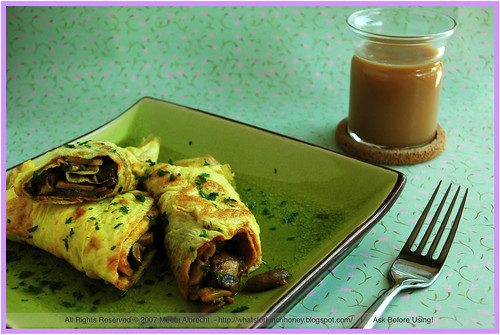
Bollywood Breakfast
An Indian Breakfast (reblogged from What's For Lunch Honey)
Bollywood Cooking: Spicy Egg and Mushroom Roll & Masala Chai
Indians love their breakfast. Each region of India has a marvelous variety of hot and cold dishes to start the day. Although in the modern cities today, with most family members working, breakfast has usually come to mean a simple sandwich or increasingly cornflakes, you will still find many families enjoying a hot breakfast every morning.
The south offers steaming hot rice cakes called idlis and pancakes called dosas. These are served with an assortment of colorful relishes made with coconuts, mangoes or hot chillies.
In Bombay (Mumbai) spiced rice slivers called pawa are cooked with onions, potatoes and green peas to provide a nutritious start to the day.
The north provides big hearty breakfasts. As farming is the main occupation of the people living here, breakfasts need to be more robust. Housewives and mums will serve their families different varieties of stuffed bread called parathas, which is accompanied with a refreshing relish and washed down with cooling lassi
Other popular dishes include fried bread served with spiced potatoes - the classic puri-bhaji, scrambled eggs and omelettes made with spices, potatoes and onions and served with flat breads or porridge made from cracked wheat or oats and served either sweetened with sugar or accompanied by hot spicy pickles.
And, not forgetting fresh fruit. Mangoes, papayas, watermelon, sapotas (chikoo in Indian), pomegranate, apples and many other types of fruit are always served at breakfast, making an excellent start to the day.
Although tea is the more common drink in many parts of India, in the south of India, coffee is the caffeine provider of choice. Many people buy the beans raw and roast them at home. Both tea and coffee are flavored with aromatic spices like cardamom, cinnamon, ginger or nutmeg.
I remember when we would visit my grandparents in New Delhi, indulging in the breakfasts prepared by my grandma was always the highlight of each day.
The day for my grandparents would begin early - at 5 AM. Once, I was about 9 or 10, I too decided to get up early and accompany my grandparents on their early morning ritual, when the rest of the family were still fast asleep. My granddad and I collected two steel containers from the kitchen and set out on the short walk to the milk depot, where every morning fresh milk was delivered. My grandfather, tall and elegant, personified a respectful figure in the community and was greeted by everyone we passed.
"Sasriakal, Bhagwan Singhji!" (Good morning, Bhagwan Sigh sir). Even his name matched the names of Gods. See, in Hindi/Punjabi Bhagwaan means God! I was always left in awe of him. He was my idol in every way.
As we arrived at the depot there were already a few people lined up, waiting for the cracked wooden doors to open. In the meantime, important chit-chat and small talk was made.

Returning home, we delivered the fresh milk to my grandma and her house-help in the kitchen, both busy with the preparations of breakfast. My granddad poured himself a large glass of the white liquid in one of the steel glasses and gulped it down in one go. That gave me the shudders as I never was the one to drink pure milk. He looked down at me, wiping the remains from his white beard and mustache.
"Come, it's time to go to the Gurdwara."
The clock had just struck six and my granddad, grandma and me quickly washed ourselves and walked to our temple. I loved going to the Gurdwara and still do whenever I visit my parents. I would look up at the pictures of our Gurus in awe, then looking at my grandfather I would smile with pride. The resemblance to our Guru Nanak Dev was uncanny.
As we got home it was still quiet around the house. My grandfather would sit on the porch and unfold his daily newspaper. Our house-help brought him a cup hot masala tea and few biscuits. It was almost seven and breakfast was not going to be ready for another hour. As I joined my grandma in the kitchen, she was busy kneading dough for fresh bread. The house-help was cutting steamed potatoes for the stuffing and I got to lay the table.
Just after eight the larger part of the family was seated at the table. My cousins, my aunts and uncles, mum and dad - all visiting from the US or Qatar gathered around to enjoy a wonderful traditional Indian breakfast. Stuffed bread, eggs, relishes, tea, milk, yogurt and fruit was plentiful and the chatter was lively. Glancing at my grandparents, I saw them nod and smile at each other, wordlessly they both knew what the other was thinking.
To honor two of my favorite people and to the memories of those wonderful times, I would like to serve you a lovely Indian breakfast.
Spicy Egg and Mushroom Roll

Ingredients
6 large eggs - beaten
Salt and pepper
Canola oil
1/2 teaspoon black cumin seeds
1/2 teaspoon turmeric powder
1/2 teaspoon red chili powder
150 g mushrooms - I used button mushrooms - sliced
Fresh cilantro leaves - chopped

Method
Season the beaten eggs with salt and pepper. Set aside.
In a heavy pan add the oil and heat. Add the cumin seeds and fry till they change color and spread a wonderful aroma.
Add all the spiced powders and then immediately add the mushrooms. Stir until the mushrooms have softened. Remove from heat and reserve.
Using a kitchen paper towel wipe the pan. Pour about a quarter of the beaten egg in a thin layer, swirling it around to even it. Once it turns golden at the bottom, flip it over and cook the other side. Keep warm and make the rest of the omelets in the same way.
Season the mushrooms with salt (adding salt to the mushrooms earlier makes them watery). To assemble the egg roll, place an omelet on a serving dish. Spread a quarter of the mushroom mixture down the middle. Sprinkle with cilantro leaves and fold both sides to make a roll.
Serve warm with toasted bread or a typical Indian flatbread (coming soon) and hot masala tea as below.
Indian Masala Chai
Tea in India is often flavored to provide a variety or to make it more healing. Brewing for fragrance and flavor, you will often be served tea with many spices and herbs. Generally, Indian tea is made by boiling the tea leaves in water and adding milk to the saucepan before it is taken off the heat. You will never see an Indian adding cold milk to their tea, as it reduces the temperature of the tea and also leaves the milk "uncooked".

Ingredients
4 small pieces fresh ginger - crushed
4 shavings nutmeg
2 cinnamon sticks
4 green cardamom pods - lightly crushed
5-7 teaspoons good quality black tea leaves
Dash of milk
Pinch of sugar
Method
In a small pot bring about 4-5 cups of water to a rolling boil. Add the ginger and the spices to the water and reduce the heat. Simmer for approx. 10 minutes.
Remove from heat and add the tea leaves. Let it steep for 5 minutes. Bring the pot back to the heat and add a dash of milk and sugar. Warm through making sure that the liquid does not boil again. This turns the tea leaves bitter.
Using a strainer, strain the brewed tea into a teapot. Enjoy hot!

Verdict
In my little family our breakfast ritual is normally reserved for the weekend. Then Tom and Soeren go down and lay the table and go to the bakery for fresh bread. In the meantime I will cook up breakfast. Whatever the craving might be. Scrambled eggs, omelets, French toast or just boiled eggs with cheese and a variety of spreads like fruit jams and honey. Sometimes, I go back to my roots and cook up a nice Indian breakfast like this. It satisfies my desire to get in touch with my roots and also takes me back down memory lane. Tom and Soeren thoroughly enjoy this kind of breakfast. Different to the usual Continental breakfasts, this is spiced and flavorful. At our table there is also chatter - about what's on schedule for the weekend. I can't help but sit back, sipping my masala tea and hope that my grandparents are looking down on us, smiling and nodding at each other knowingly.
Indians love their breakfast. Each region of India has a marvelous variety of hot and cold dishes to start the day. Although in the modern cities today, with most family members working, breakfast has usually come to mean a simple sandwich or increasingly cornflakes, you will still find many families enjoying a hot breakfast every morning.
The south offers steaming hot rice cakes called idlis and pancakes called dosas. These are served with an assortment of colorful relishes made with coconuts, mangoes or hot chillies.
In Bombay (Mumbai) spiced rice slivers called pawa are cooked with onions, potatoes and green peas to provide a nutritious start to the day.
The north provides big hearty breakfasts. As farming is the main occupation of the people living here, breakfasts need to be more robust. Housewives and mums will serve their families different varieties of stuffed bread called parathas, which is accompanied with a refreshing relish and washed down with cooling lassi
Other popular dishes include fried bread served with spiced potatoes - the classic puri-bhaji, scrambled eggs and omelettes made with spices, potatoes and onions and served with flat breads or porridge made from cracked wheat or oats and served either sweetened with sugar or accompanied by hot spicy pickles.
And, not forgetting fresh fruit. Mangoes, papayas, watermelon, sapotas (chikoo in Indian), pomegranate, apples and many other types of fruit are always served at breakfast, making an excellent start to the day.
Although tea is the more common drink in many parts of India, in the south of India, coffee is the caffeine provider of choice. Many people buy the beans raw and roast them at home. Both tea and coffee are flavored with aromatic spices like cardamom, cinnamon, ginger or nutmeg.
I remember when we would visit my grandparents in New Delhi, indulging in the breakfasts prepared by my grandma was always the highlight of each day.
The day for my grandparents would begin early - at 5 AM. Once, I was about 9 or 10, I too decided to get up early and accompany my grandparents on their early morning ritual, when the rest of the family were still fast asleep. My granddad and I collected two steel containers from the kitchen and set out on the short walk to the milk depot, where every morning fresh milk was delivered. My grandfather, tall and elegant, personified a respectful figure in the community and was greeted by everyone we passed.
"Sasriakal, Bhagwan Singhji!" (Good morning, Bhagwan Sigh sir). Even his name matched the names of Gods. See, in Hindi/Punjabi Bhagwaan means God! I was always left in awe of him. He was my idol in every way.
As we arrived at the depot there were already a few people lined up, waiting for the cracked wooden doors to open. In the meantime, important chit-chat and small talk was made.
Returning home, we delivered the fresh milk to my grandma and her house-help in the kitchen, both busy with the preparations of breakfast. My granddad poured himself a large glass of the white liquid in one of the steel glasses and gulped it down in one go. That gave me the shudders as I never was the one to drink pure milk. He looked down at me, wiping the remains from his white beard and mustache.
"Come, it's time to go to the Gurdwara."
The clock had just struck six and my granddad, grandma and me quickly washed ourselves and walked to our temple. I loved going to the Gurdwara and still do whenever I visit my parents. I would look up at the pictures of our Gurus in awe, then looking at my grandfather I would smile with pride. The resemblance to our Guru Nanak Dev was uncanny.
As we got home it was still quiet around the house. My grandfather would sit on the porch and unfold his daily newspaper. Our house-help brought him a cup hot masala tea and few biscuits. It was almost seven and breakfast was not going to be ready for another hour. As I joined my grandma in the kitchen, she was busy kneading dough for fresh bread. The house-help was cutting steamed potatoes for the stuffing and I got to lay the table.
Just after eight the larger part of the family was seated at the table. My cousins, my aunts and uncles, mum and dad - all visiting from the US or Qatar gathered around to enjoy a wonderful traditional Indian breakfast. Stuffed bread, eggs, relishes, tea, milk, yogurt and fruit was plentiful and the chatter was lively. Glancing at my grandparents, I saw them nod and smile at each other, wordlessly they both knew what the other was thinking.
To honor two of my favorite people and to the memories of those wonderful times, I would like to serve you a lovely Indian breakfast.
Spicy Egg and Mushroom Roll
Ingredients
6 large eggs - beaten
Salt and pepper
Canola oil
1/2 teaspoon black cumin seeds
1/2 teaspoon turmeric powder
1/2 teaspoon red chili powder
150 g mushrooms - I used button mushrooms - sliced
Fresh cilantro leaves - chopped
Method
Season the beaten eggs with salt and pepper. Set aside.
In a heavy pan add the oil and heat. Add the cumin seeds and fry till they change color and spread a wonderful aroma.
Add all the spiced powders and then immediately add the mushrooms. Stir until the mushrooms have softened. Remove from heat and reserve.
Using a kitchen paper towel wipe the pan. Pour about a quarter of the beaten egg in a thin layer, swirling it around to even it. Once it turns golden at the bottom, flip it over and cook the other side. Keep warm and make the rest of the omelets in the same way.
Season the mushrooms with salt (adding salt to the mushrooms earlier makes them watery). To assemble the egg roll, place an omelet on a serving dish. Spread a quarter of the mushroom mixture down the middle. Sprinkle with cilantro leaves and fold both sides to make a roll.
Serve warm with toasted bread or a typical Indian flatbread (coming soon) and hot masala tea as below.
Indian Masala Chai
Tea in India is often flavored to provide a variety or to make it more healing. Brewing for fragrance and flavor, you will often be served tea with many spices and herbs. Generally, Indian tea is made by boiling the tea leaves in water and adding milk to the saucepan before it is taken off the heat. You will never see an Indian adding cold milk to their tea, as it reduces the temperature of the tea and also leaves the milk "uncooked".
Ingredients
4 small pieces fresh ginger - crushed
4 shavings nutmeg
2 cinnamon sticks
4 green cardamom pods - lightly crushed
5-7 teaspoons good quality black tea leaves
Dash of milk
Pinch of sugar
Method
In a small pot bring about 4-5 cups of water to a rolling boil. Add the ginger and the spices to the water and reduce the heat. Simmer for approx. 10 minutes.
Remove from heat and add the tea leaves. Let it steep for 5 minutes. Bring the pot back to the heat and add a dash of milk and sugar. Warm through making sure that the liquid does not boil again. This turns the tea leaves bitter.
Using a strainer, strain the brewed tea into a teapot. Enjoy hot!
Verdict
In my little family our breakfast ritual is normally reserved for the weekend. Then Tom and Soeren go down and lay the table and go to the bakery for fresh bread. In the meantime I will cook up breakfast. Whatever the craving might be. Scrambled eggs, omelets, French toast or just boiled eggs with cheese and a variety of spreads like fruit jams and honey. Sometimes, I go back to my roots and cook up a nice Indian breakfast like this. It satisfies my desire to get in touch with my roots and also takes me back down memory lane. Tom and Soeren thoroughly enjoy this kind of breakfast. Different to the usual Continental breakfasts, this is spiced and flavorful. At our table there is also chatter - about what's on schedule for the weekend. I can't help but sit back, sipping my masala tea and hope that my grandparents are looking down on us, smiling and nodding at each other knowingly.
Subscribe to:
Posts (Atom)