Satisfy your inner hobbit with this traditional hearty high tea recipe, reblogged from Recipewise.co.uk... Steep a pot of English Breakfast and visit their site for helpful step by step instructions. Cheers!
As a child and living so close Tolkien might perhaps have been a fan of the properly made and commercially sold Melton Mowbray Pork Pie. There really is no other pork pie quite it’s equal. Melton, in Mowbray, Leicestershire, is the area located from where these famous Victorian pies were first sold (from the 1830′s). Made with a hot water crust pastry and proper pork ‘jelly’ this would have been a firm favourite taken at tea. Today, when people say pork pie, this is the standard pie they think of. We would make a large, round, hand-raised pie for this, following the recipe given.
Melton in Mowbray is a small market town located in north Leicester, central England; an area also famous for its Stilton Cheese. Although made earlier in the local rural farms in Mowbray the first of these now famous pies started to appear commercially in the 1830′s and have been on sale ever since. Under European Law only pies made within a designated zone around Melton, and using uncured pork, are allowed to carry the Melton Mowbray name on their packaging, (if sold commercially).
The most traditional, and the best Pork Pies sold in Melton are still the hand-made and hand-raised ones, as given in the Victorian recipe below. The pie pastry, when freshly made (unlike a long-life shop bought pie) is fantastic, crispy on the outside and soft and yielding on the inside, from being soaked in the stock. A stock (to form the clear jelly) is always added to the hand-cut pork pie filling after baking, it is added because the meat expands during cooking and shrinks on cooling, leaving a gap under the pie lid.
The Original MELTON MOWBRAY PORK PIE Recipe
This recipe comes from a collection of local and regional recipes handed down within families who lived and worked in Leicestershire, many dating from the 1800s, via ‘Country Dishes’ by Barbara Hargreves (Ed.) published in 1962.
To make 1 pie: The Crust. 3/4 lb plain flour, 6 oz lard, 1/2 teaspoonful salt, 4 fluid oz water.
The Filling: 1 lb pork (failing flitch, use shoulder, and if bought buy 1 1/4 lb (625g) to allow trimming) 1 level teaspoonful salt, 1/2 level teaspoonful pepper, 2 tablespoonfuls water.
The Crust. Put lard and water in saucepan and bring to the boil to melt the lard. Meanwhile weigh and sieve flour and salt, then pour lard and water (while still boiling) over the flour and mix well. Knead well by hand. Leave to cool about and hour but during this time knead once or twice. The dough must not get really cold otherwise it will crack and crumble. Turn onto floured board. Flour mould (the traditional Leicestershire pie mould is wooden, but a 2 lb jam-jar will do), put crust on top of mould and shape it from the top some way down the sides. The crust should be about 1/3 inch (1cm) thick. Leave to set for 20 minutes, then turn crust of mould and trim with scissors.
The Filling. Mince the meat on coarse knife of mincer or chop finely with a knife; add salt and pepper and mix in, add water and mix again. Press meat well into corners of pie, filling within 3/4 inch (2cm) of the top. Make the lid out of the pastry trimmings, press the edges together. Cut round to neaten off – this cutting also helps to bind the top and sides together. Castellate the top with thumb and first finger, make one hole with a skewer and decorate with stars or leaves.
Cut a length of greaseproof paper about 1 inch (2.5cm) higher than the pie, wind it round the pie making sure it goes right down the bottom, and stick it together with flour paste. This holds the pie in position. The pie need not be baked on the same day – in fact it is improved by standing overnight.
To cook, put the pie on a sandwich tin with 1 inch (2.5cm) edges – allowing plenty of room around the pie – and place on baking tray. Cook at 350 degrees F (180C) for the first hour, then turn oven to 300 degrees F (160C) and give pie another 45 minutes. The sandwich tin will re-absorb the fat. When the pie is nearly cold make a small hole in the top and add jelly. The jelly is made from bones and rind, just covered with water, simmered for 2 hours, then strained and seasoned. It should be poured into pie 1 hour after it comes out of oven.
Thursday, June 28, 2012
Friday, June 1, 2012
Light as a swan feather, the dessert fit for a ballerina
Pavlova is a meringue-based dessert named after the Russian ballet dancer Anna Pavlova. It is a meringue dessert with a crisp crust and soft, light inside. The name is pronounced /pævˈloʊvə/ or /pɑːvˈloʊvə/, unlike the name of the dancer, which was /ˈpɑːvləvə/ or /ˈpævləvə/.
The dessert is believed to have been created in honour of the dancer either during or after one of her tours to Australia and New Zealand in the 1920s.
The following listed as the "best" pav recipe, from AllRecipes.com
Ingredients
Servings: 12
Amount Per Serving Calories: 186
Total Fat: 9.3g
Cholesterol: 34mg
Here is the link showing how to build the gorgeous swan pav shown
The nationality of its creator has been a source of argument between the two nations for many years, but formal research indicates New Zealand as the source. The dessert is a popular dish and an important part of the national cuisine of both countries, and with its simple recipe, is frequently served during celebratory and holiday meals.
Origin
Research shows the recipe originated in New Zealand.[6] Keith Money, a biographer of Anna Pavlova, wrote that a hotel chef in Wellington, New Zealand, created the dish when Pavlova visited there in 1926 on her world tour.
Professor Helen Leach, a culinary anthropologist at the University of Otago in New Zealand, has compiled a library of cookbooks containing 667 pavlova recipes from more than 300 sources.[6] Her book, The Pavlova Story: A Slice of New Zealand’s Culinary History, states that the first Australian pavlova recipe was created in 1935 while an earlier version was penned in 1929[2] in the rural magazine.
The Australian website "Australian Flavour" gives the earlier date of 1926 for its creation, suggesting that Home Cookery for New Zealand, by Australian writer Emily Futter, contained a recipe for "Meringue with Fruit Filling". This recipe was similar to today's version of the dessert.
It has been claimed that Bert Sachse created the dish at the Esplanade Hotel in Perth, Australia in 1935. In defence of his claim as inventor of the dish, a relative of Sachse's wrote to Leach suggesting that Sachse may have accidentally dated the recipe incorrectly. Leach replied they would not find evidence for that "because it's just not showing up in the cookbooks until really the 1940s in Australia." (However, a 1937 issue of the Australian Women's Weekly contains a "pavlova sweet cake" recipe.) Of such arguments, Matthew Evans, a restaurant critic for The Sydney Morning Herald, said that it was unlikely that a definitive answer about the pavlova's origins would ever be found. "People have been doing meringue with cream for a long time, I don't think Australia or New Zealand were the first to think of doing that."
The first known recorded recipe named "pavlova" was published in the fifth Australian edition of Davis Dainty Dishes in 1926. However this "pavlova" recipe was not meringue based, but was instead a multi-coloured gelatine dish.
A newspaper article from January 1927 claims an American ice-cream was named after Pavlova: "Dame Nellie Melba, of course, has found fame apart from her art in the famous sweet composed of peaches and cream, while Mme. Anna Pavlova lends her name to a popular variety of American ice-cream." Preparation and consumption
Pavlova is made by beating egg whites (and sometimes salt) to a very stiff consistency before folding in caster sugar, white vinegar, cornflour, and sometimes vanilla essence, and slow-baking the mixture, similarly to meringue.
The major difference between the pavlova and a large meringue is the addition of cornflour, which results in the pavlova having a crisp and crunchy outer shell, and a soft, moist marshmallow-like centre, unlike meringue which is usually solid throughout. The consistency also makes the pavlova significantly more fragile than meringue. Because the Pavlova is notorious for deflating if exposed to cold air, when cooking is complete it is left in the oven to fully cool down before the oven door is opened.
Pavlova is traditionally decorated with a topping of whipped cream and fresh soft fruit such as kiwifruit, passionfruit, and strawberries. Factory-made pavlovas can be purchased at supermarkets and decorated as desired. A commercial product is available that includes pre-mixed ingredients for baking the meringue shell, requiring only the addition of water and sugar.
Leftover decorated pavlova can be refrigerated overnight, but the dessert will absorb moisture and lose its crispness. Undecorated pavlova can be left overnight in the oven, or for several days in an airtight container, to be decorated when ready.
In culture
World's largest pavlova -- Te Papa, New Zealand's national museum in Wellington, celebrated its first birthday in February 1999 with the creation of the world's largest pavlova, named "Pavzilla", which was cut by the Prime Minister of the time, Jenny Shipley. This record was broken by students at the Eastern Institute of Technology in Hawke's Bay, New Zealand in March 2005. Their creation 'Pavkong' stretched 64 metres long in comparison to Te Papa's 45 metre long pavlova. In August 2010, chef Aaron Campbell displayed a 50 square metre rugby-themed pavlova, with the Bledisloe Cup in the centre, in the ChristChurch Cathedral in Christchurch, to raise money for the official charity of the All Blacks.
NZI advertising campaign -- In 2007, insurance company NZI ran a humorous series of television advertisements in New Zealand highlighting what are locally considered to be historic New Zealand icons being adopted elsewhere, including the pavlova playing on its status as a common feature of the friendly trans-Tasman rivalry. NZI's parent company is Australian owned.
[fact source: Wikipedia]
The following listed as the "best" pav recipe, from AllRecipes.com
Ingredients
- 3 egg whites
- 1 pinch salt
- 1 cup white sugar
- 1 tablespoon cornstarch
- 1 teaspoon lemon juice
- 1 1/4 cups heavy whipping cream
- 1/2 cup confectioners' sugar
- 1 pint fresh strawberries
- Preheat oven to 300 degrees F (150 degrees C). Line a sheet pan with parchment paper. Draw a 9 inch circle on the parchment. An easy way to do this is to draw around the outside of a 9 inch pan with a pencil.
- In a large bowl, beat egg whites on high speed until soft peaks form. Add 3/4 cup of the sugar gradually, while continuing to whip. Make sure sugar is completely dissolved. Mix together the remaining 1/4 cup sugar with the cornstarch; lightly fold into meringue with lemon juice.
- Spread a layer of meringue to fit circle on parchment, approximately 1/4 inch thick. With remainder of mixture, pipe or spoon swirls around the edges to form a shallow bowl shape.
- Bake at 300 degrees F (150 degrees C) for 1 hour. Turn off oven, but leave meringue in oven for an additional 30 minutes. When cool, the meringue should be hard on the outside, and slightly moist on the inside.
- In a large bowl, combine the cream and half a cup of confectioners sugar, and whip until thickened. Decorate with fruit of your choice; strawberries are excellent.
Servings: 12
Amount Per Serving Calories: 186
Total Fat: 9.3g
Cholesterol: 34mg
Here is the link showing how to build the gorgeous swan pav shown
The nationality of its creator has been a source of argument between the two nations for many years, but formal research indicates New Zealand as the source. The dessert is a popular dish and an important part of the national cuisine of both countries, and with its simple recipe, is frequently served during celebratory and holiday meals.
Origin
Research shows the recipe originated in New Zealand.[6] Keith Money, a biographer of Anna Pavlova, wrote that a hotel chef in Wellington, New Zealand, created the dish when Pavlova visited there in 1926 on her world tour.
Professor Helen Leach, a culinary anthropologist at the University of Otago in New Zealand, has compiled a library of cookbooks containing 667 pavlova recipes from more than 300 sources.[6] Her book, The Pavlova Story: A Slice of New Zealand’s Culinary History, states that the first Australian pavlova recipe was created in 1935 while an earlier version was penned in 1929[2] in the rural magazine.
The Australian website "Australian Flavour" gives the earlier date of 1926 for its creation, suggesting that Home Cookery for New Zealand, by Australian writer Emily Futter, contained a recipe for "Meringue with Fruit Filling". This recipe was similar to today's version of the dessert.
It has been claimed that Bert Sachse created the dish at the Esplanade Hotel in Perth, Australia in 1935. In defence of his claim as inventor of the dish, a relative of Sachse's wrote to Leach suggesting that Sachse may have accidentally dated the recipe incorrectly. Leach replied they would not find evidence for that "because it's just not showing up in the cookbooks until really the 1940s in Australia." (However, a 1937 issue of the Australian Women's Weekly contains a "pavlova sweet cake" recipe.) Of such arguments, Matthew Evans, a restaurant critic for The Sydney Morning Herald, said that it was unlikely that a definitive answer about the pavlova's origins would ever be found. "People have been doing meringue with cream for a long time, I don't think Australia or New Zealand were the first to think of doing that."The first known recorded recipe named "pavlova" was published in the fifth Australian edition of Davis Dainty Dishes in 1926. However this "pavlova" recipe was not meringue based, but was instead a multi-coloured gelatine dish.
A newspaper article from January 1927 claims an American ice-cream was named after Pavlova: "Dame Nellie Melba, of course, has found fame apart from her art in the famous sweet composed of peaches and cream, while Mme. Anna Pavlova lends her name to a popular variety of American ice-cream." Preparation and consumption
Pavlova is made by beating egg whites (and sometimes salt) to a very stiff consistency before folding in caster sugar, white vinegar, cornflour, and sometimes vanilla essence, and slow-baking the mixture, similarly to meringue.
The major difference between the pavlova and a large meringue is the addition of cornflour, which results in the pavlova having a crisp and crunchy outer shell, and a soft, moist marshmallow-like centre, unlike meringue which is usually solid throughout. The consistency also makes the pavlova significantly more fragile than meringue. Because the Pavlova is notorious for deflating if exposed to cold air, when cooking is complete it is left in the oven to fully cool down before the oven door is opened.
Pavlova is traditionally decorated with a topping of whipped cream and fresh soft fruit such as kiwifruit, passionfruit, and strawberries. Factory-made pavlovas can be purchased at supermarkets and decorated as desired. A commercial product is available that includes pre-mixed ingredients for baking the meringue shell, requiring only the addition of water and sugar.
Leftover decorated pavlova can be refrigerated overnight, but the dessert will absorb moisture and lose its crispness. Undecorated pavlova can be left overnight in the oven, or for several days in an airtight container, to be decorated when ready.
In culture
World's largest pavlova -- Te Papa, New Zealand's national museum in Wellington, celebrated its first birthday in February 1999 with the creation of the world's largest pavlova, named "Pavzilla", which was cut by the Prime Minister of the time, Jenny Shipley. This record was broken by students at the Eastern Institute of Technology in Hawke's Bay, New Zealand in March 2005. Their creation 'Pavkong' stretched 64 metres long in comparison to Te Papa's 45 metre long pavlova. In August 2010, chef Aaron Campbell displayed a 50 square metre rugby-themed pavlova, with the Bledisloe Cup in the centre, in the ChristChurch Cathedral in Christchurch, to raise money for the official charity of the All Blacks.
NZI advertising campaign -- In 2007, insurance company NZI ran a humorous series of television advertisements in New Zealand highlighting what are locally considered to be historic New Zealand icons being adopted elsewhere, including the pavlova playing on its status as a common feature of the friendly trans-Tasman rivalry. NZI's parent company is Australian owned.
[fact source: Wikipedia]
Friday, May 11, 2012
Putting Mom on a Pedestal .... a Cake Pedestal
This exquisite confection is a labor of love, but the results are well worth the effort
TOTAL TIME:2 hr 20 min, Prep:2 hr 0 min, Inactive Prep:--
Cook:20 min
YIELD:One 8-inch cake, LEVEL:Difficult
INGREDIENTS
SPONGE CAKE:
LEMON CURD:
MERINGUE:
MOTHER'S DAY CAKE:
DIRECTIONS
Baking the Lemon Sponge:
Preheat oven to 350degreesF, with rack in center of the oven. Line two 8-inch cake pans with parchment paper and grease the paper. Beat the sugar, zest, and eggs in a stand mixer using the whip attachment, on high speed for about 5 minutes. The eggs will be light in color and very thick. Sift the flour over the egg mixture and fold it in carefully with a rubber spatula. Pour into the prepared pans and quickly spread it out evenly. Bake for about 18-20 minutes or until a tester comes out clean.
To make the Lemon Curd:
In a large bowl, whisk together the yolks and sugar. Whisk in the lemon juice, salt and zest. Place the bowl over a medium sized saucepot that has an inch of simmering water in it. Using a tempered rubber spatula stir the lemon mixture over the heat until it thickens. This can take 5 to 10 minutes. As the lemon curd thickens it should cling to the rubber spatula. It will be thick like a pudding. Remove from the heat and stir in the butter. Strain the curd into a container and cover with plastic. Put in the freezer for about 15 minutes, or until the curd is cold but not frozen. Remove and place in refrigerator until ready to use. It will be good for up to 5 days in the refrigerator.
To make the meringue:
Whisk together the egg whites, sugar and salt in the bowl of your stand mixer. Rest the bowl over a pot of simmering water to form a double boiler. Scrape down the sides of the bowl so that all the sugar is off the sides of the bowl. Continue to stir the mixture until all the sugar is melted into the eggs and you no longer feel any graininess when rubbed between your fingers, about 3-5 minutes. Place the bowl onto your mixer, add the vanilla and salt, whisk on high speed until the meringue is thick and glossy and the bowl is just warmer than room temperature, about 8 minutes.
To assemble the cake:
Cut each of the cakes in 2 layers. Place one layer of the cake on a 8-inch cardboard cake round. Spread 1/4 cup preserves on the cake, followed by 1/4 cup lemon curd. Repeat with the next two layers of cake, preserves and lemon curd. Finally, top with the last layer of cake. To decorate the cake: Use a large rose tip, to make the flowers and to pipe the striped base. Starting at the top edge of the cake with the narrow end of the rose tip facing up, pipe a continuous spiral all the way down the cake, being careful to overlap the previous stripe. Use a propane blowtorch to lightly toast the meringue; which gives it a lovely marshmallow flavor. (Be very careful to do this on a fireproof surface.) The cake can also be served without toasting the meringue; the pure white icing is also gorgeous. For information and a how-to video about piping the roses visit www.zoebakes.com.
YIELD:One 8-inch cake, LEVEL:Difficult
INGREDIENTS
SPONGE CAKE:
- 1 cup flour
- 2/3 cup sugar
- 1 teaspoon zest of lemon
- 5 large eggs, room temperature
LEMON CURD:
- 6 large egg yolks
- 1 cup sugar
- 3/4 cup lemon juice
- pinch salt
- zest of 1 lemon
- 2 tablespoons unsalted butter
MERINGUE:
- 1 cup egg whites
- 2 cups sugar
- 1/2 teaspoon vanilla
- pinch salt
MOTHER'S DAY CAKE:
- 1 recipe Sponge Cake (see above)
- 1 recipe Lemon Curd (see above)
- 1 recipe Meringue (see above)
- 3/4 cup raspberry jam
DIRECTIONS
Baking the Lemon Sponge:
Preheat oven to 350degreesF, with rack in center of the oven. Line two 8-inch cake pans with parchment paper and grease the paper. Beat the sugar, zest, and eggs in a stand mixer using the whip attachment, on high speed for about 5 minutes. The eggs will be light in color and very thick. Sift the flour over the egg mixture and fold it in carefully with a rubber spatula. Pour into the prepared pans and quickly spread it out evenly. Bake for about 18-20 minutes or until a tester comes out clean.
To make the Lemon Curd:
In a large bowl, whisk together the yolks and sugar. Whisk in the lemon juice, salt and zest. Place the bowl over a medium sized saucepot that has an inch of simmering water in it. Using a tempered rubber spatula stir the lemon mixture over the heat until it thickens. This can take 5 to 10 minutes. As the lemon curd thickens it should cling to the rubber spatula. It will be thick like a pudding. Remove from the heat and stir in the butter. Strain the curd into a container and cover with plastic. Put in the freezer for about 15 minutes, or until the curd is cold but not frozen. Remove and place in refrigerator until ready to use. It will be good for up to 5 days in the refrigerator.
To make the meringue:
Whisk together the egg whites, sugar and salt in the bowl of your stand mixer. Rest the bowl over a pot of simmering water to form a double boiler. Scrape down the sides of the bowl so that all the sugar is off the sides of the bowl. Continue to stir the mixture until all the sugar is melted into the eggs and you no longer feel any graininess when rubbed between your fingers, about 3-5 minutes. Place the bowl onto your mixer, add the vanilla and salt, whisk on high speed until the meringue is thick and glossy and the bowl is just warmer than room temperature, about 8 minutes.
To assemble the cake:
Cut each of the cakes in 2 layers. Place one layer of the cake on a 8-inch cardboard cake round. Spread 1/4 cup preserves on the cake, followed by 1/4 cup lemon curd. Repeat with the next two layers of cake, preserves and lemon curd. Finally, top with the last layer of cake. To decorate the cake: Use a large rose tip, to make the flowers and to pipe the striped base. Starting at the top edge of the cake with the narrow end of the rose tip facing up, pipe a continuous spiral all the way down the cake, being careful to overlap the previous stripe. Use a propane blowtorch to lightly toast the meringue; which gives it a lovely marshmallow flavor. (Be very careful to do this on a fireproof surface.) The cake can also be served without toasting the meringue; the pure white icing is also gorgeous. For information and a how-to video about piping the roses visit www.zoebakes.com.
[source: Cooking Channel TV]
Thursday, March 29, 2012
When life gives you lemons... make a chiffon pie!
It’s National Lemon Chiffon Cake Day! An insurance salesman named Harry Baker invented chiffon cake in the 1920s. He sold his cakes to the Brown Derby restaurant in Los Angeles and all of Hollywood fell in love with the dessert’s lighter-than-air texture. Baker carefully guarded the recipe for over twenty years before selling it to General Mills (home of the Betty Crocker brand) for an undisclosed amount.
The recipe for chiffon cake debuted in a 1948 edition of Better Homes and Gardens. General Mills marketed it as “the first new cake in 100 years” and it quickly became a nationwide sensation. The secret recipe called for vegetable oil instead of butter or shortening, and instructed the baker to beat the egg whites and egg yolks separately.
There are many flavors of chiffon cake including chocolate, orange, walnut, maple, and today’s reason to celebrate, lemon! To celebrate National Lemon Chiffon Cake Day, try baking a delicious lemon chiffon cake for your family tonight!" [punchbowl.com]
Ingredients
- 7 eggs, separated
- 2 cups all-purpose flour
- 1-1/2 cups sugar
- 3 teaspoons baking powder
- 1 teaspoon salt
- 3/4 cup water
- 1/2 cup canola oil
- 4 teaspoons grated lemon peel
- 2 teaspoons vanilla extract
- 1/2 teaspoon cream of tartar
- 1/3 cup butter, softened
- 3 cups confectioners' sugar
- 1/4 cup lemon juice
- 4-1/2 teaspoons grated lemon peel
- Dash salt
Directions
- Place egg whites in a large bowl; let stand at room temperature for 30 minutes.
- In a large bowl, combine the flour, sugar, baking powder and salt. In another bowl, whisk the egg yolks, water, oil, lemon peel and vanilla; add to dry ingredients and beat until well blended. Add cream of tartar to egg whites; beat on medium speed until soft peaks form. Fold into batter.
- Gently spoon into an ungreased 10-in. tube pan. Cut through batter with a knife to remove air pockets. Bake on the lowest oven rack at 325° for 50-55 minutes or until cake springs back when lightly touched. Immediately invert pan; cool completely, about 1 hour.
- Run a knife around sides and center tube of pan. Remove cake to a serving plate. In a small bowl, combine frosting ingredients; beat until smooth. Frost top of cake. Yield: 12-16 servings.
Nutritional Facts1 slice equals 345 calories, 13 g fat (4 g saturated fat), 100 mg cholesterol, 288 mg sodium, 54 g carbohydrate, 1 g fiber, 4 g protein.
Sunday, March 11, 2012
Coffee Spanish Torrijas
Ingredients:
- 1 (14 oz.) can Sweetened Condensed Milk, divided
- 1/3 cup strong brewed coffee, plus 4 tsp., divided
- 3/4 teaspoon vanilla extract
- 1 large egg
- 2 to 3 tablespoons butter
- 1 (6 oz.) loaf French bread, cut into 16 (1/2-inch) slices
- Ground cinnamon
Instructions:
- HEAT oven to 250°F. Place small baking sheet in oven.
- WHISK together 2/3 cup sweetened condensed milk, 1/3 cup coffee and vanilla in large bowl. Whisk egg in medium shallow bowl until blended.
- HEAT 1 tablespoon oil in large skillet over medium heat. Dip one bread slice at a time in milk mixture, then in beaten egg, turning to coat both sides. Place 5 to 6 slices in heated skillet. Cook until browned, about 1 to 2 minutes per side. Place on baking sheet in oven to keep warm. Repeat with remaining slices adding more oil as needed.
- COMBINE remaining sweetened condensed milk and 4 teaspoons coffee in small bowl to make topping. Drizzle topping over warm bread slices just before serving. Sprinkle with cinnamon.
- For a citrus topping, stir 1 teaspoon lime juice and 1/4 teaspoon grated lime peel into topping.
Yield: 6-8 servings / Prep Time: 10 Minutes / Cook Time: 5 Minutes
(reblogged from CakeSpy.com)
Sunday, March 4, 2012
Bollywood Breakfast
An Indian Breakfast (reblogged from What's For Lunch Honey)
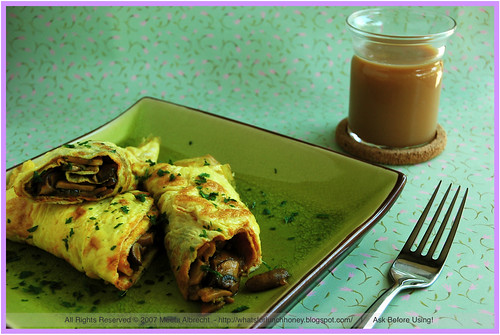
Bollywood Cooking: Spicy Egg and Mushroom Roll & Masala Chai
Indians love their breakfast. Each region of India has a marvelous variety of hot and cold dishes to start the day. Although in the modern cities today, with most family members working, breakfast has usually come to mean a simple sandwich or increasingly cornflakes, you will still find many families enjoying a hot breakfast every morning.
The south offers steaming hot rice cakes called idlis and pancakes called dosas. These are served with an assortment of colorful relishes made with coconuts, mangoes or hot chillies.
In Bombay (Mumbai) spiced rice slivers called pawa are cooked with onions, potatoes and green peas to provide a nutritious start to the day.
The north provides big hearty breakfasts. As farming is the main occupation of the people living here, breakfasts need to be more robust. Housewives and mums will serve their families different varieties of stuffed bread called parathas, which is accompanied with a refreshing relish and washed down with cooling lassi
Other popular dishes include fried bread served with spiced potatoes - the classic puri-bhaji, scrambled eggs and omelettes made with spices, potatoes and onions and served with flat breads or porridge made from cracked wheat or oats and served either sweetened with sugar or accompanied by hot spicy pickles.
And, not forgetting fresh fruit. Mangoes, papayas, watermelon, sapotas (chikoo in Indian), pomegranate, apples and many other types of fruit are always served at breakfast, making an excellent start to the day.
Although tea is the more common drink in many parts of India, in the south of India, coffee is the caffeine provider of choice. Many people buy the beans raw and roast them at home. Both tea and coffee are flavored with aromatic spices like cardamom, cinnamon, ginger or nutmeg.
I remember when we would visit my grandparents in New Delhi, indulging in the breakfasts prepared by my grandma was always the highlight of each day.
The day for my grandparents would begin early - at 5 AM. Once, I was about 9 or 10, I too decided to get up early and accompany my grandparents on their early morning ritual, when the rest of the family were still fast asleep. My granddad and I collected two steel containers from the kitchen and set out on the short walk to the milk depot, where every morning fresh milk was delivered. My grandfather, tall and elegant, personified a respectful figure in the community and was greeted by everyone we passed.
"Sasriakal, Bhagwan Singhji!" (Good morning, Bhagwan Sigh sir). Even his name matched the names of Gods. See, in Hindi/Punjabi Bhagwaan means God! I was always left in awe of him. He was my idol in every way.
As we arrived at the depot there were already a few people lined up, waiting for the cracked wooden doors to open. In the meantime, important chit-chat and small talk was made.
Returning home, we delivered the fresh milk to my grandma and her house-help in the kitchen, both busy with the preparations of breakfast. My granddad poured himself a large glass of the white liquid in one of the steel glasses and gulped it down in one go. That gave me the shudders as I never was the one to drink pure milk. He looked down at me, wiping the remains from his white beard and mustache.
"Come, it's time to go to the Gurdwara."
The clock had just struck six and my granddad, grandma and me quickly washed ourselves and walked to our temple. I loved going to the Gurdwara and still do whenever I visit my parents. I would look up at the pictures of our Gurus in awe, then looking at my grandfather I would smile with pride. The resemblance to our Guru Nanak Dev was uncanny.
As we got home it was still quiet around the house. My grandfather would sit on the porch and unfold his daily newspaper. Our house-help brought him a cup hot masala tea and few biscuits. It was almost seven and breakfast was not going to be ready for another hour. As I joined my grandma in the kitchen, she was busy kneading dough for fresh bread. The house-help was cutting steamed potatoes for the stuffing and I got to lay the table.
Just after eight the larger part of the family was seated at the table. My cousins, my aunts and uncles, mum and dad - all visiting from the US or Qatar gathered around to enjoy a wonderful traditional Indian breakfast. Stuffed bread, eggs, relishes, tea, milk, yogurt and fruit was plentiful and the chatter was lively. Glancing at my grandparents, I saw them nod and smile at each other, wordlessly they both knew what the other was thinking.
To honor two of my favorite people and to the memories of those wonderful times, I would like to serve you a lovely Indian breakfast.
Spicy Egg and Mushroom Roll
Ingredients
6 large eggs - beaten
Salt and pepper
Canola oil
1/2 teaspoon black cumin seeds
1/2 teaspoon turmeric powder
1/2 teaspoon red chili powder
150 g mushrooms - I used button mushrooms - sliced
Fresh cilantro leaves - chopped
Method
Season the beaten eggs with salt and pepper. Set aside.
In a heavy pan add the oil and heat. Add the cumin seeds and fry till they change color and spread a wonderful aroma.
Add all the spiced powders and then immediately add the mushrooms. Stir until the mushrooms have softened. Remove from heat and reserve.
Using a kitchen paper towel wipe the pan. Pour about a quarter of the beaten egg in a thin layer, swirling it around to even it. Once it turns golden at the bottom, flip it over and cook the other side. Keep warm and make the rest of the omelets in the same way.
Season the mushrooms with salt (adding salt to the mushrooms earlier makes them watery). To assemble the egg roll, place an omelet on a serving dish. Spread a quarter of the mushroom mixture down the middle. Sprinkle with cilantro leaves and fold both sides to make a roll.
Serve warm with toasted bread or a typical Indian flatbread (coming soon) and hot masala tea as below.
Indian Masala Chai
Tea in India is often flavored to provide a variety or to make it more healing. Brewing for fragrance and flavor, you will often be served tea with many spices and herbs. Generally, Indian tea is made by boiling the tea leaves in water and adding milk to the saucepan before it is taken off the heat. You will never see an Indian adding cold milk to their tea, as it reduces the temperature of the tea and also leaves the milk "uncooked".
Ingredients
4 small pieces fresh ginger - crushed
4 shavings nutmeg
2 cinnamon sticks
4 green cardamom pods - lightly crushed
5-7 teaspoons good quality black tea leaves
Dash of milk
Pinch of sugar
Method
In a small pot bring about 4-5 cups of water to a rolling boil. Add the ginger and the spices to the water and reduce the heat. Simmer for approx. 10 minutes.
Remove from heat and add the tea leaves. Let it steep for 5 minutes. Bring the pot back to the heat and add a dash of milk and sugar. Warm through making sure that the liquid does not boil again. This turns the tea leaves bitter.
Using a strainer, strain the brewed tea into a teapot. Enjoy hot!
Verdict
In my little family our breakfast ritual is normally reserved for the weekend. Then Tom and Soeren go down and lay the table and go to the bakery for fresh bread. In the meantime I will cook up breakfast. Whatever the craving might be. Scrambled eggs, omelets, French toast or just boiled eggs with cheese and a variety of spreads like fruit jams and honey. Sometimes, I go back to my roots and cook up a nice Indian breakfast like this. It satisfies my desire to get in touch with my roots and also takes me back down memory lane. Tom and Soeren thoroughly enjoy this kind of breakfast. Different to the usual Continental breakfasts, this is spiced and flavorful. At our table there is also chatter - about what's on schedule for the weekend. I can't help but sit back, sipping my masala tea and hope that my grandparents are looking down on us, smiling and nodding at each other knowingly.
Indians love their breakfast. Each region of India has a marvelous variety of hot and cold dishes to start the day. Although in the modern cities today, with most family members working, breakfast has usually come to mean a simple sandwich or increasingly cornflakes, you will still find many families enjoying a hot breakfast every morning.
The south offers steaming hot rice cakes called idlis and pancakes called dosas. These are served with an assortment of colorful relishes made with coconuts, mangoes or hot chillies.
In Bombay (Mumbai) spiced rice slivers called pawa are cooked with onions, potatoes and green peas to provide a nutritious start to the day.
The north provides big hearty breakfasts. As farming is the main occupation of the people living here, breakfasts need to be more robust. Housewives and mums will serve their families different varieties of stuffed bread called parathas, which is accompanied with a refreshing relish and washed down with cooling lassi
Other popular dishes include fried bread served with spiced potatoes - the classic puri-bhaji, scrambled eggs and omelettes made with spices, potatoes and onions and served with flat breads or porridge made from cracked wheat or oats and served either sweetened with sugar or accompanied by hot spicy pickles.
And, not forgetting fresh fruit. Mangoes, papayas, watermelon, sapotas (chikoo in Indian), pomegranate, apples and many other types of fruit are always served at breakfast, making an excellent start to the day.
Although tea is the more common drink in many parts of India, in the south of India, coffee is the caffeine provider of choice. Many people buy the beans raw and roast them at home. Both tea and coffee are flavored with aromatic spices like cardamom, cinnamon, ginger or nutmeg.
I remember when we would visit my grandparents in New Delhi, indulging in the breakfasts prepared by my grandma was always the highlight of each day.
The day for my grandparents would begin early - at 5 AM. Once, I was about 9 or 10, I too decided to get up early and accompany my grandparents on their early morning ritual, when the rest of the family were still fast asleep. My granddad and I collected two steel containers from the kitchen and set out on the short walk to the milk depot, where every morning fresh milk was delivered. My grandfather, tall and elegant, personified a respectful figure in the community and was greeted by everyone we passed.
"Sasriakal, Bhagwan Singhji!" (Good morning, Bhagwan Sigh sir). Even his name matched the names of Gods. See, in Hindi/Punjabi Bhagwaan means God! I was always left in awe of him. He was my idol in every way.
As we arrived at the depot there were already a few people lined up, waiting for the cracked wooden doors to open. In the meantime, important chit-chat and small talk was made.
Returning home, we delivered the fresh milk to my grandma and her house-help in the kitchen, both busy with the preparations of breakfast. My granddad poured himself a large glass of the white liquid in one of the steel glasses and gulped it down in one go. That gave me the shudders as I never was the one to drink pure milk. He looked down at me, wiping the remains from his white beard and mustache.
"Come, it's time to go to the Gurdwara."
The clock had just struck six and my granddad, grandma and me quickly washed ourselves and walked to our temple. I loved going to the Gurdwara and still do whenever I visit my parents. I would look up at the pictures of our Gurus in awe, then looking at my grandfather I would smile with pride. The resemblance to our Guru Nanak Dev was uncanny.
As we got home it was still quiet around the house. My grandfather would sit on the porch and unfold his daily newspaper. Our house-help brought him a cup hot masala tea and few biscuits. It was almost seven and breakfast was not going to be ready for another hour. As I joined my grandma in the kitchen, she was busy kneading dough for fresh bread. The house-help was cutting steamed potatoes for the stuffing and I got to lay the table.
Just after eight the larger part of the family was seated at the table. My cousins, my aunts and uncles, mum and dad - all visiting from the US or Qatar gathered around to enjoy a wonderful traditional Indian breakfast. Stuffed bread, eggs, relishes, tea, milk, yogurt and fruit was plentiful and the chatter was lively. Glancing at my grandparents, I saw them nod and smile at each other, wordlessly they both knew what the other was thinking.
To honor two of my favorite people and to the memories of those wonderful times, I would like to serve you a lovely Indian breakfast.
Spicy Egg and Mushroom Roll
Ingredients
6 large eggs - beaten
Salt and pepper
Canola oil
1/2 teaspoon black cumin seeds
1/2 teaspoon turmeric powder
1/2 teaspoon red chili powder
150 g mushrooms - I used button mushrooms - sliced
Fresh cilantro leaves - chopped
Method
Season the beaten eggs with salt and pepper. Set aside.
In a heavy pan add the oil and heat. Add the cumin seeds and fry till they change color and spread a wonderful aroma.
Add all the spiced powders and then immediately add the mushrooms. Stir until the mushrooms have softened. Remove from heat and reserve.
Using a kitchen paper towel wipe the pan. Pour about a quarter of the beaten egg in a thin layer, swirling it around to even it. Once it turns golden at the bottom, flip it over and cook the other side. Keep warm and make the rest of the omelets in the same way.
Season the mushrooms with salt (adding salt to the mushrooms earlier makes them watery). To assemble the egg roll, place an omelet on a serving dish. Spread a quarter of the mushroom mixture down the middle. Sprinkle with cilantro leaves and fold both sides to make a roll.
Serve warm with toasted bread or a typical Indian flatbread (coming soon) and hot masala tea as below.
Indian Masala Chai
Tea in India is often flavored to provide a variety or to make it more healing. Brewing for fragrance and flavor, you will often be served tea with many spices and herbs. Generally, Indian tea is made by boiling the tea leaves in water and adding milk to the saucepan before it is taken off the heat. You will never see an Indian adding cold milk to their tea, as it reduces the temperature of the tea and also leaves the milk "uncooked".
Ingredients
4 small pieces fresh ginger - crushed
4 shavings nutmeg
2 cinnamon sticks
4 green cardamom pods - lightly crushed
5-7 teaspoons good quality black tea leaves
Dash of milk
Pinch of sugar
Method
In a small pot bring about 4-5 cups of water to a rolling boil. Add the ginger and the spices to the water and reduce the heat. Simmer for approx. 10 minutes.
Remove from heat and add the tea leaves. Let it steep for 5 minutes. Bring the pot back to the heat and add a dash of milk and sugar. Warm through making sure that the liquid does not boil again. This turns the tea leaves bitter.
Using a strainer, strain the brewed tea into a teapot. Enjoy hot!
Verdict
In my little family our breakfast ritual is normally reserved for the weekend. Then Tom and Soeren go down and lay the table and go to the bakery for fresh bread. In the meantime I will cook up breakfast. Whatever the craving might be. Scrambled eggs, omelets, French toast or just boiled eggs with cheese and a variety of spreads like fruit jams and honey. Sometimes, I go back to my roots and cook up a nice Indian breakfast like this. It satisfies my desire to get in touch with my roots and also takes me back down memory lane. Tom and Soeren thoroughly enjoy this kind of breakfast. Different to the usual Continental breakfasts, this is spiced and flavorful. At our table there is also chatter - about what's on schedule for the weekend. I can't help but sit back, sipping my masala tea and hope that my grandparents are looking down on us, smiling and nodding at each other knowingly.
Monday, February 27, 2012
Happiness is as happiness does
We all want happiness. Its pursuit was deemed so vital an ‘unalieable’ right by our founding fathers that they penned it into our country’s charter. But what exactly is this thing called happiness? How can you describe it? How can you quantify it? These questions and more exist at the core of Positive Psychology, or the Science of Happiness.
The preponderance of 20th Century psychology has dealt with the “disease model” of the mind, focusing on what makes human beings mentally unhealthy. Abraham Maslow’s “self-actualization” brought attention to qualities of the optimal experience. But it wasn’t until 1998 that happiness became a focus of study, when Martin Seligman delivered an address to the American Psychological Association, calling for his colleagues’ return to the roots of their discipline, identifying and realizing what makes for an extraordinary human life experience.
Their subsequent work has produced findings many consider surprising. For instance, most blue-collar working folk are as happy as rich people, and teenagers from working class families describe themselves as happier than teenagers from affluent families. Surveys in many countries conducted over decades indicate that, on average, happiness levels have not increased over the last four decades, despite significant increases in real income per capita.
Research bears out that once your basic needs are met, additional income does little to raise your sense of life satisfaction. Same goes for education, weather and youth. Even spending time with the kids failed to top the charts. When it comes to marriage, “it’s complicated.” Married people tend to be happier than singles, but it is suggested that may be because they were happier to begin with. As for success, it has been concluded that happiness brings success, not the other way around
The Road to Happyville
So what then makes us happiest? Faith, family friends. In a world where so many of us relate electronically it is noteworthy that Positive Psychologists stress the importance of social skills and support through close interpersonal ties, however those are cultivated.
After reading a dozen or so self-proclaimed definitive “Top #” lists promising the keys to the happiness kingdom, here is what they collectively boiled down to when it comes to how to get happy. (put in c’mon get happy vid here)
- gratitude
- acts of altruism
- relationships, emotional intimacy... and forgiveness
- meaningful vocations or avocations. getting involved in something bigger than yourself
- savoring the present moment
- meditation
So are there any benefits to this happiness business above and beyond the obvious? Plenty. Happiness seems to have nearly magical properties. Just as stress can trigger ill health, so can friendship and happiness have a salubrious effect. The current science suggests it leads to longer life, better health, greater resilience and improved performance in most pursuits. It can add 9 years to life... that’s 3 times as many years as the increase in life expectancy associated with quitting smoking!
And the best news of all? It’s highly contagious!
What makes you happy? Please share your thoughts and joy on Facebook.
Monday, February 13, 2012
The love affair that never ends
![]() |
| "True love stories never have endings." ~Richard Bach |
I am in week 2 of my Monday host duties with Women as Visionaries and had every intention of blogging as pre-planned on the topic of each individual's distinct, intrinsic, and indiminishable value. But...
I got a bit sidetracked...
by Valentine's Day.
[Did any of you just sigh or roll your eyes?]
The commercial promotion of the 'day of love' as well as the searing reminder that one does not have a love interest with whom to share it.... or perhaps not the 'one' for whom he or she yearns most... has caused not a little in the way of tears, melancholy and pathos in general... not to mention many a Top 40 hit. But even though I have had very little true romance in my own life and am not in a romantic relationship at present, I absolutely relish Valentine's Day. To me it represents the opportunity to express love to all... not just the one.
Remember as a grade schooler, how you would give out Valentine's to the whole class? That is the kind of Valentine attitude I share and celebrate -- a recognition and appreciation of everyone in my sphere whom I adore. To me the day serves as a reminder to pause for a moment, and thoughtfully regard our loved ones with an eye to why we care about them so deeply -- and what makes them so unique and indispensable to us.
Even more thrilling is the thought that at that very moment someone somewhere is thinking the same of you. You are unique to someone. You are indispensable. You are loved!
And why? It is so beautifully simple.
Because you are you. ♥
Monday, February 6, 2012
Vision's fine line
Each Monday in February I will be serving as 'host' for the new InJoy series on the Facebook pages run by Woman as Visionaries, with Lore Raymond. The activity looks to afford opportunities to glean inspiration, share ideas, make some lovely new connections, and hopefully learn a thing or two. As a nod to the overall theme, my focus topic during the month is EnJoying Who You Truly Are. In considering how to approach the project, I began by regarding the audience to whom I'd be speaking -- visionaries.
These days, if you say the word visionary what most often comes to mind is someone like Steve Jobs... or for a SoCal kid like me, Walt Disney. These were men who saw beyond the limitations of what had been deemed the way to do things up until any given moment. They saw what was possible... and determined to make it not only doable, but practical. In so doing, they have left not only laudable personal legacies, but they grew successful businesses that have thrived after their passing, and helped create products that delight millions of fans... many of whom are willing to wait in long lines in order to be a part of the magic these men have made real.
Interestingly, shrewd businesses accumen and fiscal forecasting do not rank highly on the definitions of the word they exemplify.
The dictionary offers this:
vi·sion·ar·y [vizh-uh-ner-ee] adjective, noun, plural -ar·ies.
adjective 1. given to or characterized by fanciful, not presently workable, or unpractical ideas, views, or schemes: a visionary enthusiast. 2. given to or concerned with seeing visions. 3. belonging to or seen in a vision. 4. unreal; imaginary: visionary evils. 5. purely idealistic or speculative; impractical; unrealizable: a visionary scheme.
noun 7. a person of unusually keen foresight. 8. a person who sees visions. 9. a person who is given to audacious, highly speculative, or impractical ideas or schemes; dreamer.
If this term is so closely related to flights of impracticable fancy... to that which is unreal and imaginary, why then do we admire and strive to emulate people who we describe as visionary? Is it not because of their pioneer spirit... can-do attitude... willingness to take risks... and unflagging belief in the practicality of industrious magic.... as born out time and again by their proven successes?
People such as these show us that successful business need not just be about making a buck. It can be about making a difference.... even making people happy!
Monday, January 23, 2012
Enter the New Year Dragon
As as child I questioned why New Year's day fell on January 1st, while Spring is the season of new birth. It just never quite quite made sense to me. I was delighted to learn that in China, New Year's is known as the "Spring Festival". Like Carnival in the West, it marks the end of the winter season.
Chinese New Year is the most important of the traditional Chinese holidays and has been observed for over 5000 years. The festival begins on the first day of the first Chinese month Zhēngyuè, in pinyin. The festivities end with the Lantern Festival on the 15th day. Whereas New Year’s Eve in the West is often celebrated as a time for single adults and couples to get dressed to the nines for an evening of Champagne, dance and an amorous moment at midnight, the Chinese celebrate their Eve by getting together for dinner with family.
The menu includes foods that are associated with wealth, happiness and good fortune, including pig, duck, chicken and sweets. During this rowdy meal, family members, especially the younger ones, are often given red envelopes that contain money in even numbers that reflect good luck and honor. Adult gifts usually include oranges, cakes, cookies, chocolates, candies, and so on. The evening concludes with fireworks, which, incidentally, originated in China.
As part of the 2 week plus event, the family will thoroughly clean their house in order to sweep away ‘ill-fortune’ to make way for good fortune. Windows and doors are then decorated with red paper cut-outs conveying the standard themes of wealth and long life.
The origin of Chinese New Year itself is based on myth and centuries-old tradition. Chinese New Year is celebrated in countries and territories with significant Chinese populations, as well as in Chinatowns worldwide, most notably stateside, in San Francisco.
The East is big in the West
The San Francisco Chinese New Year celebration began in the 1860's during the Gold Rush era and is now the largest event of its kind outside of Asia. The festivities include two major fairs, the Chinese New Year Flower Fair and Chinatown Community Street Fair, all which culminate in their official parade, which is named among the world’s top ten parades.
Highlights include elaborately decorated floats, marching bands, martial arts demonstrators, stilt walkers, lion dancers, Chinese acrobatics, the year’s Miss Chinatown USA and the piece de resistance, the Golden Dragon -- a 200+ feet long ‘costume’ with a 6’ head. It is trimmed with rainbow pompons, colored lights and white rabbit fur. Made of bamboo and rattan skeleton, it requires a team of 100 men and women to carry the Golden Dragon. The dragon’s grande finale appearance is accompanied by 600,000 firecrackers.
For those of us who have either not quite gotten around to our new year’s resolutions, or may have perhaps already abandoned them, this colorful celebration of Spring and its promise offers renewed hope and expectation around the world.
Tuesday, January 17, 2012
"Selfish" Recipes
January is the month of resolutions... most of which tend to fall under the category of 'self-help'.... so in that vein we offer the following self-centered recipes from The Delicious Miss Dahl
The BBC's "Sophie Dahl revels in the joy of cooking for one on a purely selfish day." Simply click on the dish of your choice below for the full recipe and instructions.
Bon appetit, and enjoy your fun for one!
The BBC's "Sophie Dahl revels in the joy of cooking for one on a purely selfish day." Simply click on the dish of your choice below for the full recipe and instructions.
Subscribe to:
Posts (Atom)